


10 Best Gothic Horror Stories by H. P. Lovecraft (1917 - 1927)

H. P. Lovecraft is today enshrined as the architect of cosmic horror—the cold visionary who stripped the universe of comfort and replaced it with vast, indifferent immensities. Alongside later masterpieces like The Call of Cthulhu and At the Mountains of Madness, his name has become virtually synonymous with tentacled gods, forbidden tomes, and existential dread on a planetary scale. The pity is that this reputation has, in some respects, obscured the quieter but no less compelling body of work that preceded it.
Before the fully formed Mythos, before the Antarctic wastes and cyclopean ruins, Lovecraft was writing something far closer to traditional Gothic fiction: tales of crumbling houses, hereditary curses, graveyards, vaults, and solitary figures gnawed by dread. These stories are often treated as apprentice work—interesting chiefly for what they anticipate rather than what they achieve.
How wrong that assumption proves to be.
The early fiction—written before his disillusioning New York years and his retreat to Providence—reveals a writer steeped not only in the influence of Edgar Allan Poe and M. R. James, but already developing a voice of remarkable atmosphere and psychological intensity. Here, the horrors are more intimate, more claustrophobic: the past festers in ancestral estates, madness whispers through bloodlines, and the supernatural intrudes not as cosmic spectacle but as something furtive, insinuating, and terribly near at hand.
And yet, even in these ostensibly “Gothic” pieces, one can feel the pressure of something larger—an intimation that the shadows crowding these narrow corridors may open, at any moment, onto abysses far beyond them. These tales are not merely juvenilia; they are the dark roots from which Lovecraft’s later cosmic visions would grow, and they remain among his most effective and enduring works.
The Picture in the House

A traveler seeking shelter from a storm stumbles upon a decaying rural cabin, where he encounters a reclusive and deeply unsettling inhabitant. As they converse, the narrator becomes aware of a large, disturbing book in the man’s possession—an illustrated volume depicting scenes of extreme brutality. The old man’s fascination with these images, coupled with hints about his diet and isolation, creates a mounting sense of unease that culminates in a moment of sudden, external interruption. Lovecraft excels here at building tension through dialogue and implication, allowing the horror to emerge gradually rather than through overt revelation. The setting, rendered with careful attention to atmosphere, contributes to the story’s claustrophobic effect. “The Picture in the House” is often cited as one of his finest short pieces, notable for its economy, its effective use of suggestion, and its ability to evoke dread from seemingly mundane elements.
The Cats of Ulthar

Set in a distant, quasi-mythical land, this brief tale recounts how the town of Ulthar came to adopt its singular law: that no man may kill a cat. The story centers on a pair of sinister outsiders whose cruelty toward animals provokes unease among the townspeople, as well as the quiet grief of a traveling boy whose beloved kitten disappears. What follows is a sequence of events that transforms local superstition into immutable decree. Lovecraft adopts a deliberately simple, almost fairy-tale style, allowing the narrative to unfold with the clarity and inevitability of folklore. Though lacking the cosmic scope of his later work, the story is effective in its restraint and its sense of moral balance. “The Cats of Ulthar” remains a favorite for its accessibility and its distinct tonal shift, offering a glimpse of Lovecraft’s versatility and his ability to evoke wonder alongside unease.
Nyarlathotep

More prose-poem than conventional story, “Nyarlathotep” unfolds as a fragmented account of a world slipping into madness under the influence of a mysterious, charismatic figure. The titular character, a wandering showman and prophet, travels from city to city, unveiling strange devices and revelations that leave devastation in their wake. The narrative shifts rapidly through dreamlike scenes—crowds in panic, landscapes in decay, and a final procession into darkness—creating a sense of disorientation that mirrors the collapse it depicts. Lovecraft abandons traditional plot in favor of impressionistic imagery, drawing the reader into a nightmare logic where cause and effect are obscured. The piece is significant for introducing one of his most enduring entities, as well as for its experimental style. Its power lies in its immediacy and intensity, offering a vivid glimpse of cosmic horror as a lived, collective experience rather than an isolated event.
The Temple
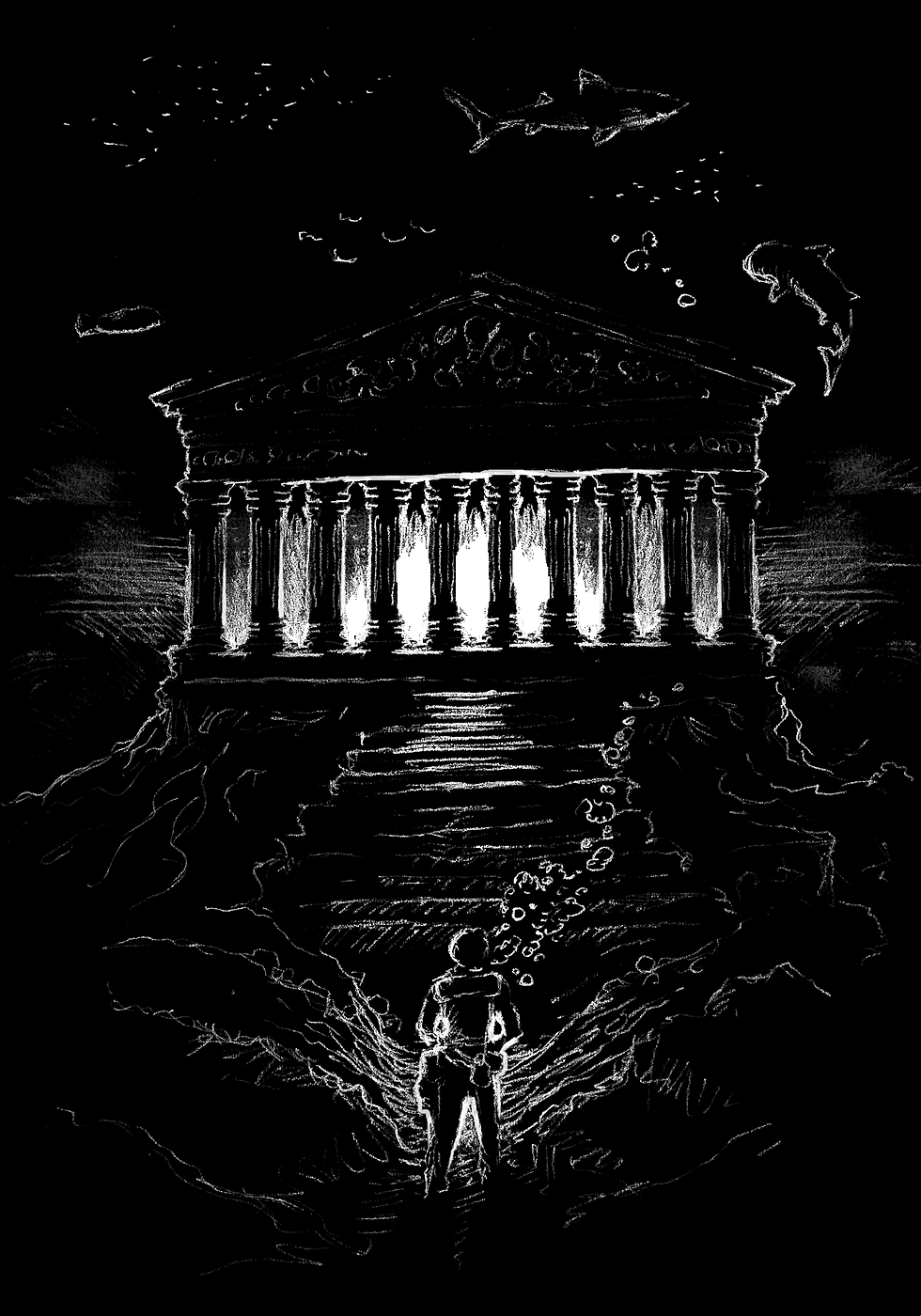
Set aboard a German U-boat during the First World War, “The Temple” chronicles the gradual unraveling of a disciplined naval officer and his crew after they recover a mysterious artifact from a sunken ship. As mechanical failures, hallucinations, and acts of insubordination multiply, the submarine drifts into increasingly uncharted waters—both literal and psychological. Lovecraft’s decision to narrate the story through the rigid, formal voice of the captain adds a layer of irony, as his insistence on order contrasts sharply with the chaos closing in around him. The underwater setting enhances the sense of isolation and inevitability, turning the vessel into a sealed chamber of mounting dread. “The Temple” is notable for its sustained structure and its effective blending of war narrative with cosmic horror. It demonstrates Lovecraft’s growing confidence in handling longer forms and his ability to build tension through gradual, inexorable decline.
The Statement of Randolph Carter

Presented as a formal deposition, this story recounts the testimony of Randolph Carter, who is found in a state of shock following a mysterious expedition into a graveyard. His companion, the occultist Harley Warren, had been investigating something buried beneath an ancient tomb, descending alone into its depths while maintaining contact via a telephone line. What Carter hears through that line—fragmentary, urgent, and increasingly incomprehensible—forms the core of the tale. Lovecraft uses the constraints of the testimonial format to great effect, limiting the narrative to what can be reported while allowing the implications to expand beyond it. The result is a story that feels both immediate and incomplete, as though only the surface of a far greater horror has been revealed. Though brief, it is significant for its introduction of themes and motifs that would recur throughout his work, particularly the dangers of forbidden knowledge.
The Outsider

In this haunting, almost allegorical narrative, a solitary figure recounts his life in a crumbling, lightless castle, cut off from human contact and driven by an aching desire to reach the world beyond. His escape leads him through a dark forest to a gathering of people, where his attempt at connection yields a moment of profound and devastating recognition. Unlike much of Lovecraft’s work, the horror here is deeply personal, rooted in isolation, identity, and the longing for belonging. The prose is richly Gothic, echoing earlier traditions while subtly subverting them. “The Outsider” stands apart for its emotional resonance and its relative simplicity, offering a rare glimpse of introspection in Lovecraft’s fiction. It is often read as a metaphor for alienation, and its enduring appeal lies in the way it transforms a familiar Gothic scenario into something quietly tragic and psychologically acute.
Pickman’s Model

Told as a monologue by a shaken Bostonian, “Pickman’s Model” recounts his acquaintance with a controversial artist whose work is so grotesquely lifelike that it repels even the most jaded viewers. As the narrator is granted a private viewing of the painter’s hidden studio, he is forced to confront images that seem less imagined than observed—scenes of subterranean horrors rendered with uncanny precision. Lovecraft builds tension through conversation and implication, allowing the narrator’s growing unease to guide the reader toward a revelation that is both understated and devastating. The story’s brilliance lies in its economy: it presents a single, chilling idea and pursues it with relentless focus. It also reflects Lovecraft’s fascination with the boundary between art and reality, suggesting that true horror may not be invented but discovered. “Pickman’s Model” remains one of his most accessible and effective tales.
The Shunned House

An aging house on the outskirts of Providence becomes the focus of a quiet but persistent dread in this measured, investigative tale. The narrator, intrigued by local rumors and guided by an antiquarian uncle, undertakes a systematic study of the building’s history, uncovering a pattern of illness, decay, and unexplained death among its occupants. As their research deepens, the house emerges not merely as a site of haunting, but as the locus of a more insidious, almost biological corruption. Lovecraft blends documentary-style narration with mounting unease, grounding the supernatural in a framework of empirical inquiry that only heightens its credibility. The story reflects his growing interest in pseudo-scientific horror, where the unknown is not dismissed but examined—and found to be far worse than superstition. Though less overtly dramatic than some of his tales, “The Shunned House” is notable for its atmosphere, structure, and its early articulation of cosmic parasitism.
The Music of Erich Zann

Set in a nameless, dreamlike quarter of a European city, this tale follows a student who becomes fascinated by his reclusive neighbor, a mute viol player named Erich Zann. Each night, Zann produces strange, increasingly frantic music—at once mesmerizing and deeply unsettling—from his attic room overlooking a dark, inaccessible void. As the narrator presses for answers, he finds himself drawn into a mystery that seems to resist language itself. Lovecraft’s restraint is key here: the horror is never explained, only suggested through sound, gesture, and mounting tension. The story’s urban setting and tightly focused narrative give it an unusual immediacy, while its ambiguity enhances its lingering effect. Often regarded as one of Lovecraft’s most artistically successful works, “The Music of Erich Zann” demonstrates his ability to evoke cosmic terror without recourse to elaborate mythology, relying instead on mood, implication, and the limits of human perception.
The Rats in the Walls

In one of H. P. Lovecraft’s most fully realized tales, an American heir restores his ancestral estate in rural England, determined to reclaim a lineage long shadowed by rumor and decay. As the house is rebuilt, however, strange disturbances begin to surface—unsettling dreams, animal panics, and the persistent sound of rats moving behind the walls. Drawn by both curiosity and a mounting sense of dread, the narrator descends into the buried history of his family, uncovering architectural and genealogical secrets that refuse to remain hidden. Lovecraft gradually shifts from antiquarian mystery to psychological horror, charting a descent that feels both inevitable and appalling. The story’s power lies in its fusion of Gothic inheritance with cosmic suggestion, and in its careful control of tone. It remains one of his most disturbing explorations of atavism, memory, and the idea that the past is never safely past.