

A Critical Introduction to William Hope Hodgson's Carnacki the Ghost-finder Mythos: A Spooky Spotlight

William Hope Hodgson is remembered today chiefly as one of the great architects of cosmic horror. Readers encounter him through the apocalyptic immensities of The House on the Borderland, the uncanny terrors of the Sargasso Sea stories, or the melancholy grandeur of The Night Land. Yet throughout his career another fascination repeatedly surfaced alongside his cosmic visions: the mystery story. Long before he invented Thomas Carnacki, Hodgson displayed an almost compulsive desire to construct puzzles whose apparently supernatural causes demanded investigation. Again and again he invited readers to confront haunted houses, ghost ships, mysterious monsters, and inexplicable manifestations, only to reveal that some concealed natural explanation—or occasionally something far stranger—lay beneath the surface.
This attraction appeared almost immediately. His earliest published fiction, "The Goddess of Death," is essentially an Arthur Conan Doyle pastiche, recalling The Hound of the Baskervilles in its combination of eerie atmosphere, false hauntings, and rational deduction. Later stories continued the pattern. "The Terror of the Water Tank" opens as a sequence of inexplicable murders apparently committed by some supernatural agency before revealing an altogether earthly—but no less horrifying—culprit lurking within an abandoned cistern. "The Stone Ship" and "The Thing in the Weeds" similarly flirt with ghostly explanations before uncovering bizarre natural phenomena. Other tales, including "The Ghosts of the Glen Doon" and "The Haunting of the Lady Shannon," likewise transform spectral legends into cleverly engineered hoaxes worthy of Arthur Conan Doyle or even a Victorian Nancy Drew.
These stories reveal an author delighting in the tension between skepticism and belief. Hodgson understood that fear grows most intense in moments of uncertainty. His characters rarely know whether they face fraud, psychology, folklore, unknown natural forces, or authentic supernatural evil, and readers are encouraged to oscillate alongside them. The pleasure lies not merely in discovering the answer but in inhabiting the unsettling ambiguity before the answer arrives. In this respect Hodgson differed from many of his contemporaries.
Writers such as M. R. James generally asked readers to accept that the supernatural was real from the outset, while detective fiction typically promised that reason would ultimately banish every ghost. Hodgson refused to make either promise. Sometimes the apparition proved to be entirely explainable. Sometimes science exposed the fraud. And sometimes science itself was forced to acknowledge realities that it could neither measure nor dismiss.
Out of this fertile uncertainty emerged one of the most original detectives in supernatural fiction. When Thomas Carnacki first appeared in 1910, Hodgson finally united his lifelong fascination with mystery, scientific speculation, folklore, and horror into a single unforgettable personality. If Sherlock Holmes represented the supreme detective of the visible world, Carnacki became its counterpart in the invisible one.
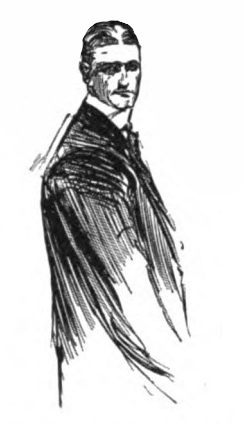
He was not the first fictional investigator of psychic mysteries. Earlier writers had already introduced occult specialists such as Sheridan Le Fanu's Dr. Martin Hesselius and Algernon Blackwood's John Silence. But Carnacki immediately distinguished himself from these scholarly predecessors. He was neither an elderly professor nor a dreamy mystic content to theorize from an armchair. Hodgson instead imagined an energetic Edwardian bachelor who carried scientific instruments alongside ancient manuscripts, who wired haunted rooms with electrical apparatus before consulting medieval grimoires, and who was just as willing to fire a revolver as to draw a protective pentacle. Somewhere between Sherlock Holmes, Abraham Van Helsing, Nikola Tesla, and—by modern comparison—Fox Mulder, Carnacki became something entirely new: the prototype of the modern paranormal investigator.
THE EARLY, LITERARY OCCULT DETECTIVES

If Sherlock Holmes represented the triumph of reason over crime, Thomas Carnacki stood at the uncertain frontier where reason itself began to falter. His profession was unprecedented. Holmes could expose counterfeit ghosts, unravel impossible murders, and reduce superstition to cold deduction, but Carnacki willingly crossed the threshold that Holmes seldom approached. He entered places where folklore, psychology, religion, and science converged—where some hauntings proved fraudulent, others misunderstood, and a disturbing few horrifyingly genuine.
This uncertainty defines Carnacki's greatest innovation. Unlike many later paranormal investigators, he neither believes everything nor dismisses anything. Every case begins as a mystery rather than a haunting. A frightened family may be suffering from a malicious practical joke, an ingenious criminal conspiracy, mass hysteria, some little-understood natural force, or the intrusion of something wholly outside ordinary experience. Carnacki refuses to privilege any explanation until the evidence has been gathered. His investigations proceed with the discipline of a detective, the curiosity of a scientist, and the caution of a folklorist. Only after exhausting ordinary possibilities does he concede that he may be confronting what he calls an "outward manifestation."
Such intellectual flexibility distinguished him sharply from the occult detectives who preceded him. Sheridan Le Fanu's Dr. Hesselius and Algernon Blackwood's John Silence are physicians of the soul as much as detectives, men whose principal tools are learning, intuition, and metaphysical insight. Carnacki, by contrast, is a man of action. He hauls cumbersome equipment into abandoned chapels, sleeps alone in haunted chambers, strings cameras and trip wires through darkened corridors, experiments with electrical apparatus, and willingly places himself in situations that every instinct tells him to flee. He is less an academic investigator than a field researcher—part engineer, part electrician, part psychologist, part folklorist, and only incidentally a detective.

The distinction reflects the age in which he was created. Edwardian Britain occupied an uneasy middle ground between Victorian certainty and modern skepticism. Electricity was transforming daily life; wireless communication seemed miraculous; X-rays had revealed invisible worlds hidden within the human body; Einstein's theories were beginning to overturn accepted notions of space and time. At the same time, public fascination with séances, spiritualism, psychical research, hypnotism, and psychic phenomena reached extraordinary heights.
Organizations devoted to investigating ghosts and telepathy attempted to apply scientific methods to questions previously reserved for religion and folklore. To many educated people, the supernatural no longer seemed merely a matter of blind faith or rustic superstition. It had become something that might, perhaps, be measured, photographed, classified, or experimentally verified.
Carnacki belongs wholly to this moment. His celebrated Electric Pentacle has become one of the iconic images of early supernatural fiction precisely because it embodies this cultural crossroads. Its glowing vacuum tubes arranged in the shape of an ancient protective symbol capture Hodgson's central conceit: modern technology need not replace ancient wisdom but might instead reinforce it. Carnacki is equally comfortable consulting the forbidden Sigsand Manuscript as he is developing photographic plates or assembling electrical equipment. He trusts medieval grimoires without becoming medieval himself. Conversely, he embraces scientific innovation without succumbing to the fashionable arrogance that assumes science has already explained everything worth knowing.
Perhaps even more remarkable than his methods is his personality. Carnacki lacks both Sherlock Holmes's emotional detachment and the infallibility often granted to fictional detectives. He is brave without being fearless. He readily confesses when terror nearly overwhelms him, admits mistakes, abandons investigations that become too dangerous, and openly acknowledges that there are powers beyond his understanding. These admissions never diminish him. On the contrary, they make him unusually human. His courage lies not in the absence of fear but in his repeated willingness to confront it.
This vulnerability may explain why Carnacki has remained beloved despite never achieving Holmes's worldwide fame. Readers recognize in him neither an omniscient genius nor an invincible action hero but an intelligent man confronting mysteries that exceed human comprehension. He prepares as thoroughly as possible, relies upon both reason and tradition, and then ventures into darkness knowing full well that his preparations may prove inadequate. His victories therefore feel earned rather than inevitable.
In many respects, Carnacki established the template for the twentieth century's paranormal investigator. Nearly every famous occult detective who followed inherits some portion of his character: the skeptical curiosity of Fox Mulder, the homemade ingenuity of the Ghostbusters, the mixture of folklore and detective work found in Kolchak: The Night Stalker, the occult scholarship of John Constantine, the monster-hunting resolve of Buffy Summers, even the rational investigation of seemingly supernatural mysteries that became the hallmark of Scooby-Doo. Few of these figures resemble Carnacki superficially, yet all owe something to Hodgson's decisive insight: that the most compelling ghost hunter is neither a mystic nor a scientist alone, but someone perpetually negotiating the uneasy boundary between the two.
HODGSON AND THE MAKING
OF A CARNACKI MYTHOS

One of the series' greatest pleasures lies not in the investigations themselves, but in the ritual through which they are recounted. Like Sherlock Holmes before him, Carnacki is introduced through a framing device that lends the stories an air of authenticity while transforming them into recollections rather than immediate adventures. Yet where Holmes's exploits emerge piecemeal through the daily companionship of Dr. Watson, Carnacki's adventures are reserved for special occasions, shared only after the danger has passed and only with a select audience of trusted friends.
At the close of each successful investigation, invitations are quietly dispatched bearing the simple instruction, "Come over at seven-thirty. Come hungry. Carnacki." Those few words have become among the most beloved recurring motifs in supernatural fiction. They promise not merely another ghost story, but an evening's fellowship—a reunion of old companions gathering around a table before venturing, through narrative, into places none of them would willingly visit in person.
The setting is equally evocative. Carnacki resides at 427 Cheyne Walk in Chelsea, a neighborhood already rich with literary associations and old London character. There, after what Hodgson repeatedly describes as a substantial meal of heavy Edwardian fare, generous wine, and excellent tobacco, conversation is deliberately withheld until the practical needs of appetite have been satisfied.
Only then do the company retire to the sitting room, light their pipes, settle into comfortable chairs, and invite Carnacki to recount the latest affair. The progression is almost liturgical. Physical comforts are first enjoyed to their fullest extent before attention turns toward the immaterial. Good food, warm company, and familiar surroundings become a deliberate counterweight against the disturbing realities soon to be described.

This ritual accomplishes more than atmospheric scene-setting. It subtly reassures both Carnacki's listeners and Hodgson's readers that the investigator has survived whatever ordeal lies ahead. The stories begin, in effect, at their endings. We meet a healthy, composed Carnacki enjoying dinner with friends before hearing of nights spent alone in abandoned chapels, haunted bedrooms, isolated country houses, or desolate landscapes where survival was anything but certain. The narrative therefore derives its suspense not from wondering whether Carnacki lives, but from discovering what he encountered—and whether the explanation will ultimately prove mundane, supernatural, or something disquietingly poised between the two.
Carnacki's audience also serves an important literary purpose. Unlike Watson, whose role is to accompany Holmes through each investigation, Hodgson's narrator, Dodgson, functions primarily as recorder and editor. He is a transparent stand-in for the author himself: sympathetic, curious, intelligent, but never intrusive. The other dinner guests remain even more indistinct, asking occasional questions that allow Carnacki to clarify technical points without ever distracting from the central narrative.
Hodgson wisely resists giving the supporting cast elaborate personalities. They exist chiefly as representatives of the reader, expressing skepticism, surprise, or fascination at precisely the moments when the audience itself is likely to do the same.
The stories therefore possess an unusual narrative rhythm. Rather than unfolding in real time, they become performances. Carnacki is not simply solving mysteries; he is interpreting them. He pauses to explain why he tried one experiment instead of another, why some piece of folklore suddenly assumed importance, or why a scientific instrument succeeded—or failed—in revealing the truth.
These retrospective reflections distinguish the series from conventional detective fiction. The pleasure lies as much in Carnacki's reasoning as in the events themselves, and because he speaks with the authority of hindsight, he can openly admit mistakes, speculate about uncertainties, or confess that some aspects of the mystery remain beyond explanation.
This willingness to preserve ambiguity is one of Hodgson's greatest strengths. Arthur Conan Doyle generally rewards Holmes with complete mastery of every case, tying each loose thread into a satisfying knot. Carnacki is afforded no such luxury. Some investigations conclude with persuasive rational explanations; others end with convincing evidence of supernatural intervention; several resist definitive interpretation altogether.

Even when the immediate danger has been overcome, larger questions frequently remain unanswered. What precisely are the "Outer Monstrosities" hinted at in the forbidden Sigsand Manuscript? How many unseen forces inhabit the margins of human perception? Does the Electric Pentacle truly repel preternatural entities, or has Carnacki merely observed a pattern without fully understanding its cause? Hodgson rarely resolves these mysteries, preferring instead to suggest a vast and only partially comprehensible cosmos whose laws remain tantalizingly obscure.
That refusal to explain everything marks a decisive departure from both detective fiction and traditional ghost stories. Carnacki neither restores perfect rational order nor surrenders entirely to supernatural chaos. Instead, he occupies an unstable middle ground where scientific investigation illuminates fragments of a much larger darkness without ever dispelling it completely. Every solved mystery hints at others that remain unsolved; every successful investigation suggests that humanity has mapped only the smallest corner of an immeasurably larger universe.
It is perhaps this quality more than any other that has preserved the stories' fascination. Readers return not simply to discover whether the ghost is real, but to spend another evening in Carnacki's company—to hear the familiar invitation, enjoy another impossible tale over pipes and port, and once again accompany a brave, intelligent, deeply human investigator to the threshold where reason ends and the unknown begins.
A SURVEY OF THE STORIES

Although the Carnacki stories are often spoken of collectively, they resist easy categorization. Hodgson never settled into a single formula, nor did he consistently decide whether Carnacki inhabited a rational universe or a genuinely supernatural one. Instead, each case becomes an experiment in possibility. Some end with entirely natural explanations, others reveal authentic hauntings, while several occupy a tantalizing middle ground where certainty remains elusive. This variety helps explain why the series has endured. Readers quickly learn that neither they nor Carnacki can ever be entirely certain what awaits behind the next locked door.
The opening tale, "The Gateway of the Monster," remains one of Hodgson's masterpieces and an ideal introduction to the detective. It contains nearly every element that would become synonymous with the series: the isolated haunted chamber, the Electric Pentacle, the forbidden Sigsand Manuscript, elaborate preparations against unseen forces, and a terrifying climax that refuses to explain more than absolutely necessary.
The story also establishes Carnacki's greatest strength as a protagonist. He is methodical enough to investigate carefully, imaginative enough to entertain impossible explanations, and humble enough to recognize that some mysteries exceed his understanding.
If the tale has a weakness, it lies only in its deliberate obscurity. Hodgson hints at a vast cosmology of "Outer Monstrosities" without defining it, leaving readers simultaneously intrigued and frustrated. Yet that very incompleteness contributes to its lasting power, suggesting horrors too immense to be comfortably understood.

If "The Gateway of the Monster" introduces Carnacki's methods, "The House Among the Laurels" showcases his detective instincts. Here the supernatural recedes into the background while the investigation assumes center stage, producing one of the author's most suspenseful adventures. The story demonstrates that Carnacki is perfectly capable of solving mysteries through observation, patience, and courage alone, and it reminds readers that human greed and cruelty may rival any ghost for menace. Although some readers consider its explanation less imaginative than those of the supernatural tales, the story broadens the detective's range and prevents the series from becoming mechanically repetitive.
The opposite approach appears in "The Whistling Room," perhaps the bleakest and most psychologically oppressive story in the cycle. Here Hodgson abandons elaborate plotting in favor of relentless atmosphere. The unseen presence haunting the ancient chamber remains one of his most unsettling creations precisely because it is never satisfactorily explained. The terrible, inhuman whistling gradually assumes an almost physical presence, overwhelming both characters and readers through suggestion rather than spectacle. Few horror writers have demonstrated greater confidence in the frightening power of sound alone.
"The Searcher of the End House" shifts attention toward emotional rather than cosmic horror. Although less celebrated than several companion stories, it is among the series' most compassionate, revealing Hodgson's concern for ordinary people caught in extraordinary circumstances. The investigation unfolds with a melancholy restraint that distinguishes it from the more sensational adventures, emphasizing loss, memory, and lingering spiritual corruption rather than violent confrontation. Its quieter pace has led some critics to undervalue it, yet its emotional subtlety rewards careful reading.

One of the most controversial entries is "The Horse of the Invisible." On the surface it appears to offer another classic haunted-house investigation, but its peculiar mixture of folklore, psychological unease, and understated supernaturalism has divided readers for generations. Admirers praise its dreamlike atmosphere and gradual accumulation of dread; detractors find its climax comparatively subdued. Whatever one's verdict, the tale demonstrates Hodgson's willingness to experiment with mood rather than relying solely upon spectacular manifestations.
Perhaps no story better illustrates Hodgson's playful relationship with detective fiction than "The Thing Invisible." Here Carnacki confronts what initially appears to be a classic locked-room mystery complicated by supernatural rumor. The resulting investigation cleverly balances rational deduction with occult possibility, inviting readers to anticipate one explanation before quietly replacing it with another. It is among the series' most satisfying demonstrations that Carnacki need not encounter authentic ghosts to remain compelling. His greatest weapon is often not his Electric Pentacle but his capacity for disciplined skepticism.

The same cannot be said of "The Haunted Jarvee," one of the cycle's strangest and most polarizing tales. Returning to Hodgson's beloved maritime setting, it places Carnacki aboard a vessel haunted by forces that seem less like traditional ghosts than manifestations of the cosmic unknown. The sea had always been Hodgson's greatest imaginative landscape, and here it again becomes a place where ordinary reality dissolves into nightmare. The story's episodic structure and elusive mythology have prevented it from enjoying the popularity of "The Gateway of the Monster," but its atmosphere of isolation and mounting dread ranks among the finest Hodgson ever achieved.
By contrast, "The Find" is generally regarded as the weakest canonical Carnacki adventure. More anecdote than fully realized investigation, it lacks the architectural precision and sustained tension of the stronger stories. Interesting ideas appear only briefly before the narrative concludes with unusual haste, leaving readers with the impression of an intriguing sketch rather than a completed composition. Even so, the tale offers glimpses of Hodgson's continuing fascination with cursed objects and lingering supernatural influence.
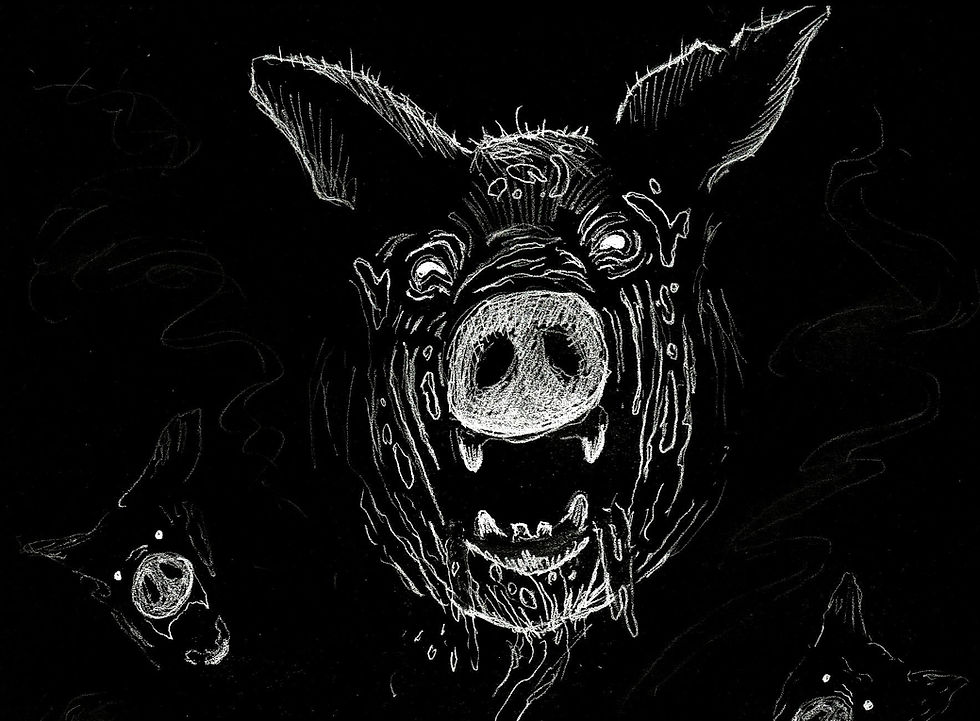
Finally comes "The Hog," perhaps the most grotesque and philosophically ambitious story in the series. Here Hodgson moves beyond conventional ghost stories into territory approaching cosmic horror, presenting one of the most disturbing entities in his fiction. The monstrous vision at the tale's center transcends ordinary hauntings, suggesting instead an objective evil existing independently of human belief or imagination. If "The Gateway of the Monster" hints at hidden dimensions beyond ordinary perception, "The Hog" tears the veil aside with terrifying force. Its conclusion is among the bleakest Hodgson ever wrote, anticipating the existential horror later associated with H. P. Lovecraft while retaining the author's distinctive fascination with spiritual realities.
Taken individually, these stories vary considerably in quality. Hodgson was an imaginative writer rather than a consistently polished craftsman, and some tales are undeniably stronger than others. Yet even the weaker entries contain memorable concepts, striking imagery, or ingenious narrative experiments. Unlike Arthur Conan Doyle, whose Holmes stories settled into a highly reliable formula, Hodgson continually tested the limits of what a Carnacki story could become. Haunted houses give way to country estates, lonely ships, cursed artifacts, invisible predators, psychological terrors, and cosmic manifestations. Some mysteries conclude triumphantly; others end ambiguously; a few conclude in outright defeat. This willingness to embrace uncertainty gives the series a freshness that many more polished detective cycles ultimately lack.
For that reason, the Carnacki stories reward reading as a complete cycle rather than merely as isolated classics. Collectively they reveal Hodgson conducting an extended exploration of fear itself—not merely asking whether ghosts exist, but investigating what kinds of horrors human beings are prepared to believe, what reason can genuinely explain, and where the boundaries of knowledge ultimately dissolve into mystery. Few supernatural detectives have traveled such varied terrain, and fewer still have done so with such an enduring combination of intellectual curiosity, imaginative boldness, and genuine terror.
READING CARNACKI CRITICALLY

Part of the enduring fascination of the Carnacki stories lies in their remarkable openness to interpretation. Unlike Sherlock Holmes, whose adventures are primarily concerned with restoring rational order, or M. R. James, whose ghosts generally function as moral retribution for curiosity or greed, Hodgson's tales resist any single explanatory framework. They have been read as celebrations of science, warnings against scientific hubris, expressions of religious belief, products of psychological trauma, and meditations on the limits of human knowledge. None of these interpretations fully explains the series, yet each reveals something essential about its peculiar power.
The most obvious reading views Carnacki as a hero of scientific modernity. Written during the first decade of the twentieth century, the stories emerged amid astonishing technological change. Electricity had transformed cities, wireless communication promised to conquer distance, X-rays had uncovered invisible realities hidden within the body, and physics itself seemed to be dissolving long-held certainties about matter, energy, and space. Carnacki embodies this optimistic spirit of experimentation.
Unlike earlier ghost hunters, he approaches the supernatural not simply with prayers and folklore, but with cameras, electrical apparatus, chemical photography, mechanical ingenuity, and a determination to observe rather than merely believe. His famous Electric Pentacle is more than a memorable invention; it symbolizes the hope that humanity's newest discoveries might illuminate even its oldest fears.

Yet Hodgson carefully avoids presenting science as omnipotent. Indeed, the stories repeatedly frustrate any confidence that technology alone can master the unknown. Cameras fail to capture crucial evidence. Elaborate preparations prove inadequate. Instruments reveal phenomena without explaining them. Carnacki survives not because science has conquered the supernatural, but because he supplements scientific investigation with folklore, ritual, historical research, intuition, and, occasionally, simple courage. In this respect, the series becomes less a triumph of science than a critique of scientific arrogance. Reason remains indispensable, but it is not sufficient. The universe proves larger than any single intellectual system can comprehend.
A second interpretation emphasizes precisely this intellectual humility. Carnacki inhabits what might be called a liminal world—a threshold between incompatible systems of understanding. He belongs neither wholly to the Enlightenment nor wholly to the medieval imagination. His investigations proceed according to scientific method while acknowledging that reality may contain dimensions inaccessible to conventional measurement.
The stories therefore reject both credulous superstition and dogmatic skepticism. Carnacki believes neither everything nor nothing. Instead, he practices what philosophers might recognize as epistemological modesty: a willingness to follow evidence wherever it leads while admitting that human knowledge possesses unavoidable limits.
This uncertainty gives the stories much of their distinctive atmosphere. Hodgson rarely asks readers simply to believe in ghosts. Rather, he invites them to experience the unsettling sensation of not knowing what categories of explanation remain available. The true source of fear often lies not in the apparition itself but in the collapse of familiar assumptions about how the world operates. Once those assumptions fail, every shadow acquires new significance.

Other critics have approached the series biographically, finding in Carnacki an expression of Hodgson's own lifelong struggle against unseen dangers. Such readings acquire particular force when considered alongside the author's extraordinary life. As a young merchant seaman, Hodgson endured years of brutal bullying, physical abuse, exhaustion, isolation, and constant exposure to the unpredictable violence of the sea.
Again and again his fiction returns to vulnerable individuals confronting immense, often invisible forces that surround them in darkness. Whether those forces take the form of monstrous sea creatures, cosmic entities, haunted houses, or intangible spiritual presences, they frequently overwhelm ordinary human expectations of safety and control.
Carnacki may therefore represent Hodgson's imaginative answer to experiences that resisted ordinary understanding. Unlike many of the author's sailors, who find themselves helpless before incomprehensible horrors, Carnacki prepares himself. He studies. He experiments. He invents. He arms himself intellectually and physically against the unknown. His investigations cannot eliminate fear, but they demonstrate that disciplined courage remains possible even when certainty disappears. The stories are therefore not fantasies of mastery but exercises in resilience. One cannot always defeat the darkness, Hodgson suggests, but one can choose how to confront it.
Still another interpretation locates the series within the religious imagination of Edwardian Britain. Hodgson's supernatural universe is strikingly unlike the secular cosmic indifference later associated with Lovecraft. Although terrifying entities undeniably exist, they do not inhabit a morally empty universe. Evil possesses objective reality. Certain places become corrupted. Ancient rituals retain genuine efficacy. Protective symbols, sacred traditions, and inherited wisdom continue to matter.
Carnacki's reliance upon forgotten manuscripts and ceremonial practices is therefore not mere antiquarian curiosity. It reflects a world in which humanity participates in an older moral and spiritual order that modern civilization has not entirely displaced.
Yet Hodgson never becomes conventionally theological. He offers remarkably little doctrinal certainty. Priests seldom intervene. Churches provide no universal refuge. Divine providence rarely appears explicitly. Instead, spiritual reality remains fragmentary and mysterious, perceived only through scattered glimpses. The resulting cosmology feels less like systematic theology than like archaeology: broken fragments of forgotten knowledge suggesting a larger pattern whose complete design has long since been lost. This quality gives the stories an unusual resonance for modern readers, many of whom share Carnacki's position somewhere between inherited belief and empirical skepticism.

Perhaps the richest interpretation, however, sees the series as dramatizing the permanent tension between curiosity and caution. Every Carnacki story begins because someone has crossed a threshold—opening a forbidden room, disturbing an ancient object, purchasing an isolated house, venturing onto an abandoned ship, or refusing to leave some mystery alone.
Curiosity drives civilization forward, but it also exposes humanity to dangers previously unseen. Carnacki himself embodies this paradox. His profession depends upon investigating precisely those mysteries that wiser people avoid. He succeeds because he refuses ignorance, yet he survives because he never mistakes knowledge for invulnerability.
This balance distinguishes Hodgson from many of his contemporaries. In some supernatural fiction, curiosity is punished as moral transgression; in much detective fiction, curiosity is rewarded with complete understanding. Carnacki inhabits neither world. Knowledge remains worth pursuing, but it always carries risk. Discovery expands the horizon only to reveal how much larger the surrounding darkness truly is.
That may explain why these stories continue to feel surprisingly modern more than a century after their publication. We inhabit an age of extraordinary technological sophistication while remaining acutely aware of the limits of our understanding—whether confronting consciousness, artificial intelligence, quantum physics, pandemics, or the vastness of the cosmos.
Carnacki would recognize the predicament immediately. He belongs to no age in which all mysteries have been solved. Rather, he reminds us that every advance in knowledge opens fresh territories of uncertainty. The unknown does not retreat; it merely changes its shape.
THE LEGACY OF THE GHOST-FINDER

Thomas Carnacki never attained the universal fame of Sherlock Holmes, nor did William Hope Hodgson live long enough to cultivate his detective into a sprawling literary franchise. Killed in action during the Fourth Battle of Ypres in April 1918 at the age of forty, Hodgson left behind only nine completed Carnacki stories and the outline of a tenth. By comparison, Arthur Conan Doyle produced fifty-six Holmes short stories and four novels, while later occult detectives would appear across dozens of books, comics, television series, and films. Carnacki's adventures therefore occupy a curious place in literary history: few in number, uneven in execution, but disproportionately influential.
Their importance becomes clearer when viewed retrospectively. Before Carnacki, fictional investigators of the supernatural generally leaned toward one of two extremes. Either they were rational detectives who exposed fraudulent hauntings or mystics who accepted the existence of the supernatural from the outset.
Hodgson refused this division. Carnacki became the first truly modern paranormal investigator—a detective whose central task was determining whether the supernatural was present before deciding how to confront it. His cases begin not with certainty but with inquiry, and their conclusions remain refreshingly unpredictable. That narrative flexibility would become the defining characteristic of countless supernatural mysteries throughout the twentieth century.

His descendants are everywhere. The investigative skepticism of Fox Mulder, the improvised technology of the Ghostbusters, the monster-hunting professionalism of John Constantine, the blend of folklore and detective work found in Kolchak, the research-driven investigations of Buffy Summers and her companions, even the familiar rhythm of skeptical investigation followed by supernatural revelation that underlies everything from Supernatural to Grimm and The X-Files—all echo principles that Hodgson refined in Carnacki's adventures. Even franchises that ultimately explain every apparent haunting through mundane means, such as Scooby-Doo, owe something to Hodgson's insistence that every mystery deserves genuine investigation before conclusions are drawn.
Nor is his influence confined to popular entertainment. Carnacki stands at an important crossroads in the history of weird fiction itself. Between the Gothic ghost stories of the nineteenth century and the cosmic horror of the twentieth, Hodgson occupies a transitional position that is uniquely his own. He inherits the haunted rooms, ancestral curses, forbidden manuscripts, and lingering spirits of writers like Le Fanu and M. R. James while simultaneously anticipating Lovecraft's fascination with hidden dimensions, ancient forces, and humanity's fragile understanding of reality. Yet unlike either tradition, Carnacki insists upon active engagement. His response to the unknown is neither passive terror nor detached scholarship, but investigation.
That spirit of inquiry may ultimately explain the stories' remarkable durability. Modern readers approach them after more than a century of scientific revolutions, technological miracles, and cultural transformations. The electrical apparatus that once seemed astonishing has become quaint. Carnacki's photographic experiments and vacuum tubes possess an unmistakable Edwardian charm.

His heavy dinners, Turkish cigarettes, bachelor apartments, and gentlemanly manners evoke a social world long vanished. Yet the questions that animate his adventures remain strikingly contemporary. How should intelligent people respond to experiences that challenge accepted explanations? What obligations do skepticism and open-mindedness owe one another? Can reason investigate mysteries without assuming in advance what their answers must be? Where does genuine science end and intellectual arrogance begin?
Hodgson offers no easy resolutions because he distrusts easy certainty. His universe is larger, stranger, and more morally complex than any single philosophy can encompass. The supernatural is neither sentimental nor theatrical. It is dangerous, elusive, and frequently indifferent to human understanding. At the same time, humanity is not powerless within that universe. Knowledge matters. Preparation matters. Tradition matters. Courage matters most of all. Carnacki survives not because he possesses perfect understanding but because he accepts imperfect understanding without surrendering either his curiosity or his resolve.
For all their ingenuity, however, the stories' greatest appeal may be simpler than any critical theory can fully explain. They are immensely enjoyable. Hodgson possessed an uncommon gift for atmosphere. Few writers have described the silence of an abandoned room, the oppressive darkness of an empty corridor, the lonely menace of an isolated country house, or the uncanny expectancy that settles over a place where something ought not to exist with equal conviction.
He understood that terror often arrives gradually: a sound heard once too often, a footprint where none should appear, a door that opens with impossible deliberation, a faint suggestion that the darkness is not merely empty but inhabited. Long before horror cinema refined these techniques, Hodgson had mastered them on the printed page.

He also understood something equally important: fear is best experienced in contrast with comfort. That is why every adventure begins not in a haunted house but in the warmth of 427 Cheyne Walk, among old friends sharing good food, good wine, and good tobacco.
The stories invite us into civilized fellowship before leading us into the wilderness beyond civilization's light. When the tale is finished, we return safely to the fireside, perhaps not entirely reassured, but grateful for its warmth. Few narrative devices capture so perfectly the ancient pleasure of telling ghost stories after dark. More than a hundred years after Carnacki first extinguished the lamps, checked the seals upon his Electric Pentacle, and listened for unseen footsteps in the darkness, readers continue to accept his invitation. We come hungry. We settle into our chairs. We wait for the pipes to be lit. Then, as the room grows quiet, Carnacki begins once more.