


Guy de Maupassant's Diary of a Madman (Un Fou), Explained: A Detailed Summary and a Literary Analysis

Updated: Sep 22
The motif of the homicidal jurist has long fascinated writers: the concept of corruption feasting from the protective seat of power. J. Sheridan Le Fanu wrote two such tales (the second a reworked prequel to the first), “Strange Disturbances in Aungier Street” and “Mr. Justice Harbottle,” both of which detail supernatural events surrounding a sadistic judge. Bram Stoker famously revamped “Aungier Street” in “The Judge’s House,” while M. R. James featured a damned justice in “The Rose Garden.” All of these judges were, in some way or another, inspired by the historical jurist Sir George “the Bloody Judge,” “the Hanging Judge” Jeffreys (1645–1689).
Maupassant’s “Diary of a Madman,” first published in 1885, belongs to the darker side of his fiction, where respectable society becomes a thin veneer concealing impulses that are considerably less civilized. The story appeared during a period of intense nineteenth-century interest in crime, criminal psychology, insanity, and the boundaries between moral depravity and mental illness.
Newspapers and popular literature alike had developed a voracious appetite for accounts of murder and criminal behavior, while physicians and alienists were increasingly attempting to classify and explain abnormal states of mind. Maupassant, who frequently turned his attention toward the unsettling psychology beneath ordinary social life, found fertile material in this fascination with the hidden self.
II.
While “Diary of a Madman” extends far beyond the morbid implications of a sadistic official presiding over capital cases, it plunges into the bald hypocrisy that Maupassant saw teeming throughout human society. As in “The Dead Girl” and “Am I Insane?,” his focus is upon the worst possible character lurking beneath the surface of social proprieties.
The horror is heightened by the narrator’s position within the very institution supposedly established to distinguish innocence from guilt, and by the gulf between the public reputation of a man and the private reality concealed behind it. “Diary” also belongs to the developing tradition of psychological crime fiction.
Maupassant was writing in the wake of Edgar Allan Poe’s pioneering explorations of murderous obsession, unreliable narration, and the strange impulses of the human mind, but “Diary of a Madman” approaches these subjects with a distinctly French naturalistic sensibility.
Its cold, matter-of-fact presentation makes the narrator’s thoughts all the more disturbing: there is no gothic castle, supernatural demon, or exotic monster to account for what follows. Instead, Maupassant places his darkness squarely within respectable nineteenth-century society. For Maupassant, this contrast between appearance and reality was one of the richest sources of human comedy—and human horror. The following journal entries gradually exposes what lies behind the impeccable façade of a man whom society has every reason to trust.
SUMMARY

“Diary of a Madman” begins with the death of an eighty-two-year-old president of a high court, a man whose entire career had been devoted to pursuing criminals and protecting the innocent. His reputation is impeccable: he is respected throughout the French judicial system, honored by the public, and mourned at his funeral. After his death, however, a notary discovers a strange manuscript in his desk, bearing the single title: “WHY?”
The manuscript begins with the judge recording the execution of a man named Blondel, who had murdered his five children. The case causes the judge to contemplate the nature of killing. He becomes fascinated by the fact that living creatures can be destroyed at will, and begins asking why murder is considered a crime when killing is so fundamental to nature.
Animals kill constantly, he observes, while human beings kill animals for food and pleasure and kill one another in war. Soldiers who kill thousands are decorated and honored, while ordinary murderers are condemned. He concludes that “to kill is the law,” and begins to regard killing as a natural and even beautiful act.
His philosophical speculation gradually becomes a personal obsession. He imagines the sensation of taking a living, thinking creature and transforming it into “a heap of limp flesh, cold, inert, void of thought.” Because he has spent his career condemning murderers to death, he wonders whether he might himself kill without being discovered. His social position, he realizes, makes him particularly safe: who would suspect a revered judge?
The temptation eventually becomes irresistible. He begins with a goldfinch belonging to his servant Jean. Taking the bird from its cage, he slowly strangles it before cutting its throat with a pair of scissors. He carefully washes the scissors and his hands, buries the corpse beneath a strawberry plant, and takes pleasure in imagining that he will eat strawberries growing above the hidden body.
Soon afterward, he decides that he must kill a human being. While walking through the forest, he encounters a young boy eating bread and butter. When the child respectfully greets him as “Mr. President,” the judge asks whether he is alone. After ensuring that no one else is nearby, he suddenly seizes the boy by the throat and strangles him. He hides the body in a ditch and returns home exhilarated, feeling “tranquil” because he has finally satisfied his desire.
When the boy's body is discovered, two tramps are arrested, but the judge remains unsuspected. His next victim is a fisherman sleeping beneath a willow tree. Finding a spade nearby, he takes it and kills the man with a single blow to the head. This time he witnesses the blood flowing and experiences intense satisfaction.
The fisherman’s nephew, who had briefly left his uncle, is accused of the murder. The judge watches as the evidence against the innocent man accumulates. He presides over the trial and ultimately condemns him to death. When the nephew is guillotined, the judge takes pleasure in watching the execution.
The diary ends without another murder. The judge has discovered that he can manipulate the machinery of justice to conceal his own crimes, while continuing to enjoy the respect of society...
After the manuscript is discovered, psychiatrists declare that there are other undiscovered madmen in the world who may be equally “adroit” and dangerous.
ANALYSIS
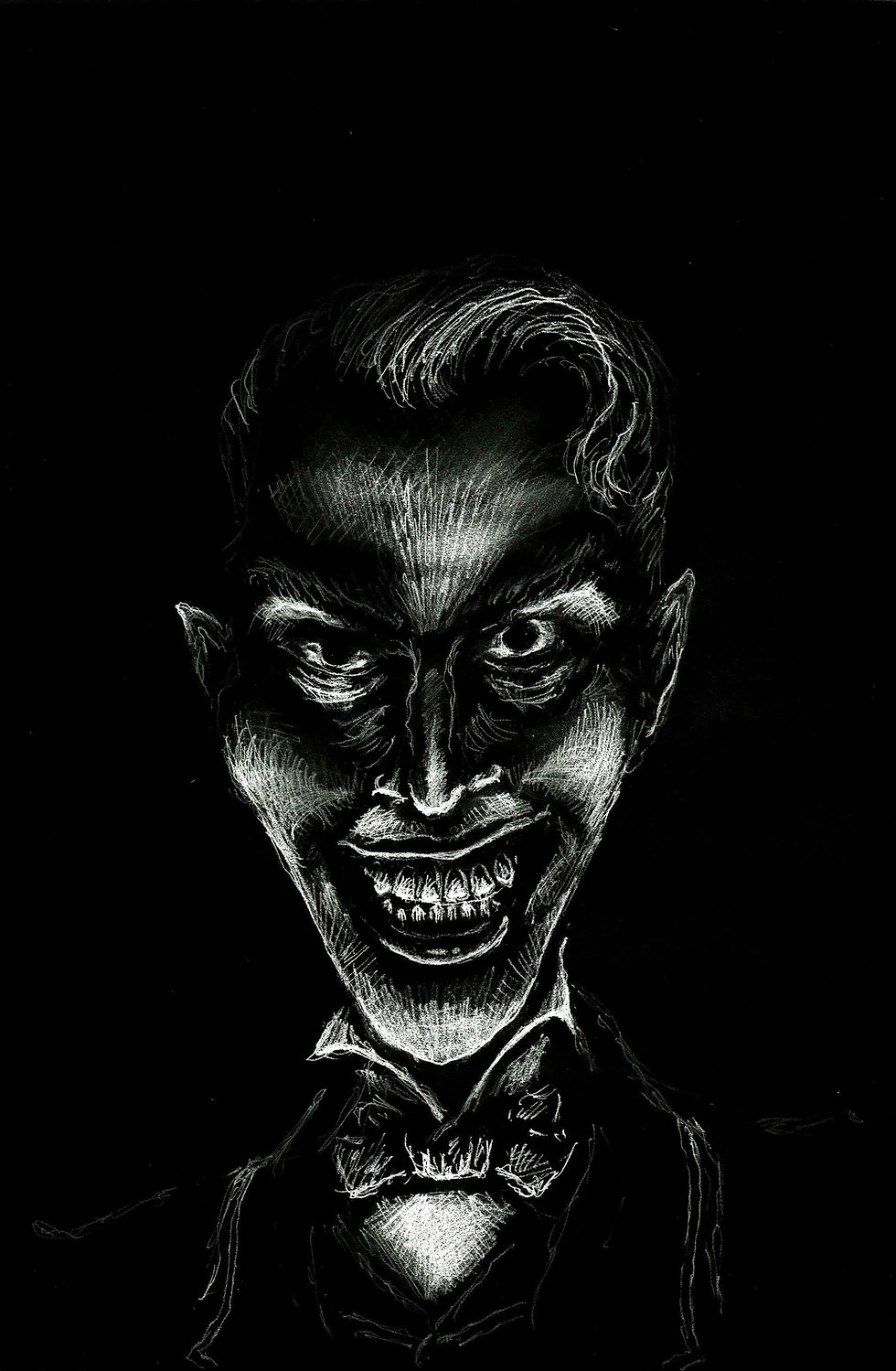
Unlike Poe’s “The Tell-Tale Heart,” “The Black Cat,” and “The Imp of the Perverse”—early studies in the psychology of homicide—Maupassant’s tale lacks the triumph of guilt and justice. Unlike “The Cask of Amontillado,” where the murderer does escape, “Diary of a Madman” lacks even a personal motive for murder. While the story clearly springboards from Poe’s homicidal fiction, it moves beyond conventional psychological explanations such as resentment, shame, fear, guilt, bitterness, greed, or vengeance, into the playing field of sheer insanity.
As such, “Diary of a Madman” is an important early work of psychological crime fiction, attempting to plumb the depths of an apparently inexplicable, animalistic homicidal impulse. The story’s most disturbing idea, however, is not simply that the judge is insane. It is that his madness can construct an entire philosophy to justify what he already desires to do. His reflections on nature, death, and the supposed necessity of killing sound almost rational at first. Every living creature kills in order to survive; human beings kill animals for food and pleasure; nations kill one another in war; society itself kills criminals through the machinery of the law.
The judge therefore asks why his own desire to kill should be regarded as uniquely monstrous. His reasoning is obviously grotesque, but Maupassant gives it enough internal logic to make the reader uncomfortable: the distinction between “legitimate” killing and murder suddenly begins to look less absolute than the judge's respectable position would suggest.
II.
This is especially pointed because the judge is himself an agent of institutional killing. He has spent his career condemning men to death, and he consequently discovers a disturbing continuity between his public duties and his private appetite. The guillotine becomes, in his imagination, an extension of the knife. His victims have merely been transferred from the category of “criminal” to “legally condemned,” while the physical act of destroying a human life remains.
Maupassant does not thereby suggest that judicial punishment and private murder are morally identical; rather, he exploits the judge’s warped reasoning to expose the terrifying ease with which an intelligent person can manipulate an abstract moral principle until it serves a monstrous appetite.
The diary structure is crucial to this effect. The opening narrator gives us the judge’s immaculate public reputation, while the diary gives us access to the private consciousness that reputation concealed. The two portraits are not merely different—they are almost perfectly contradictory. The man who supposedly “protected the weak” has selected the vulnerable precisely because they are unlikely to threaten him. His professional ability to read the minds of criminals is transformed into an ironic advantage: he knows exactly how investigators think, how evidence is constructed, and how easily an accusation can be made to stick.
His greatest protection is not physical strength but credibility. This also makes the story a particularly bleak examination of social trust. The judge repeatedly marvels that nobody suspects him. When the fisherman’s nephew is accused, he takes pleasure not merely in having killed but in watching the machinery of justice manufacture the wrong culprit.
His position allows him to occupy both sides of the criminal process: he is simultaneously the hidden murderer and one of the men empowered to determine who will be punished for murder. The resulting irony is almost Swiftian in its cruelty. The institution designed to uncover guilt becomes the murderer’s camouflage.
III.
There is also an important progression in the diary itself. The judge begins with an abstract fascination with death, then experiments upon an animal, then kills a child, then commits another murder, and finally condemns an innocent man to death for his own crime. Each stage removes another barrier between thought and action.
Yet Maupassant deliberately avoids presenting this as a conventional descent into madness in which the murderer becomes increasingly incoherent. Quite the opposite: the narrator often becomes more methodical as his crimes become more terrible. He cleans his scissors, conceals the bird, observes the investigation, and studies the evidence against the fisherman’s nephew.
His insanity is compatible with intelligence, self-control, and social success—a point underscored by the final observation that other undiscovered madmen may be equally “adroit” and dangerous.
The “Diary” therefore anticipates a particularly modern conception of the hidden criminal: not the wild-eyed outcast, the Satanist, the cannibal, or the Gothic aristocrat, but the apparently ordinary and socially respected individual whose private life is radically at odds with his public identity. Maupassant's bourgeois murderer is frightening precisely because nothing about his appearance makes him remarkable. His authority, education, manners, and reputation do not restrain his impulses; they help conceal them.
The final reference to alienist physicians adds another layer of irony. The nineteenth century increasingly sought to understand criminality through medicine and psychology, and the term “alienist” itself reflects this emerging attempt to classify abnormal mental states. Yet the physicians' conclusion offers little comfort. They can identify the narrator as a “monstrous lunatic,” but they cannot explain how such a man lived for decades among respectable society without detection.
The medical explanation therefore arrives after the horror rather than resolving it. If anything, it enlarges the problem: the judge may be an exceptional madman, but the possibility remains that others like him are moving unnoticed through the world. Maupassant's story also belongs to a larger nineteenth-century fascination with the idea that civilization may be only a thin covering over primitive impulses.
His narrator takes this idea literally. He repeatedly reduces human beings to living organisms driven by appetite, reproduction, aggression, and death. But there is a delicious irony in the reduction: the judge's attempt to explain humanity in purely naturalistic terms becomes itself a product of his deranged imagination. He has mistaken an observation about nature for a moral law.
Animals may kill because they must; human beings, possessing reason and moral agency, are capable of deciding whether they ought to kill. His philosophical argument is therefore less an explanation of murder than an elaborate intellectual alibi for it.
IV.
The story's relationship to Poe is especially interesting in this regard. Poe's murderers are frequently trapped inside their own consciousness: guilt, paranoia, obsession, or some perverse psychological compulsion ultimately turns inward upon them. Maupassant removes much of that inward punishment. His judge experiences no remorse and almost no fear. Indeed, his pleasure comes partly from discovering how little his conscience troubles him.
That makes the story colder than many of Poe's tales. The horror does not depend upon the murderer being punished by his own mind; it depends upon discovering that his mind may not punish him at all. This is one reason “Diary of a Madman” has proved so durable within horror and crime fiction. Its central conceit—the respectable authority figure who is secretly a murderer—has become a recurring archetype, particularly in stories about serial killers whose intelligence, profession, or social standing protects them from suspicion.
Maupassant's story appeared decades before the modern cultural image of the serial killer fully developed, and before Jack the Ripper transformed the popular imagination of anonymous multiple murder in 1888. Earlier crime literature certainly contained serial or repeat murderers, but they were often presented as sensational abnormalities: aristocratic monsters, occultists, cannibals, or figures of folkloric evil.
Maupassant instead locates the monster inside the institutions of respectable society. Its influence is also visible in film. The story (which is loosely adapted together with elements of “The Horla,” Dr. Jekyll and Mr. Hyde, House of Wax, and Roger Corman’s Poe Cycle – especially The Haunted Palace and The Pit and the Pendulum) was adapted into the 1963 horror film Diary of a Madman, directed by Reginald Le Borg and starring Vincent Price as an upstanding French magistrate and amateur sculptor named Simon Cordier who is suddenly possessed and morally corrupted by a parasitic Horla – depicted as an otherworldly genius of envious rage and lust – that transforms him into a psychopath, leading to the graphic murder of his married lover and a fiery finale, a la “The Horla,” the lurid details of which are shockingly revealed to his scandalized friends during posthumous reading of his journal.
The adaptation substantially expands Maupassant's extremely compressed premise, adding characters, a sculptor's studio, supernatural elements, and a more conventional horror narrative. The film thus illustrates both the strength and flexibility of Maupassant's original idea: the respectable judge concealing a murderous darkness can be transplanted from psychological realism into Gothic and supernatural horror without losing its basic power.
VI.
Perhaps the “Diary’s” greatest achievement, however, is its refusal to provide the reader with a comfortable explanation. The judge is mad, but madness does not completely explain him. He is intelligent, but intelligence does not restrain him. He is respected, but respectability does not make him good. He is an officer of justice, but justice itself becomes the instrument of his deception.
By the end, Maupassant has inverted the familiar crime story: the mystery is not who committed the murder, but how a murderer could occupy the very seat from which murder was condemned—and remain there, honored and trusted, until death.
In this respect, it extends beyond the story of one homicidal judge. It is a study in the terrifying distance between social identity and private reality, and in the possibility that civilization's most reassuring institutions can be manipulated by the very people entrusted with maintaining them.
Maupassant pulls back the curtain on a thoroughly bourgeois killer—neither a degenerate cannibal nor an aristocratic vampire—and discovers something considerably more disturbing: a monster who looks, to everyone around him, like a perfectly respectable man.