

Guy de Maupassant's On the River (Sur l'Eau), Explained: A Detailed Summary and Literary Analysis

Updated: Aug 18
Certainly one of de Maupassant’s greatest horror masterpieces, “On the River” prefigures a variety of river-set tales of terror, like Blackwood’s “The Willows” and Cobb’s “Fish-head.” Consisting of a wide poetic palette, “On the River” identifies riverscapes as places of hidden horror and subtle fear—deceptive sources of spiritual punishment. Like Blackwood, de Maupassant suggests that the river is a lonely and menacing setting, a landscape redolent with danger and brooding antagonism. He relates the river—a backyard neighbor compared to the vast and exotic ocean—to an unsuspecting killer, much like the diarist in “Diary of a Madman,” a relationship made even more distinct in the tale’s grisly conclusion.
What truly sets “On the River” apart, however, is its mastery of setting and imagery. What other writers have characterized as living, rushing, joyful, sparkling, sunny, and thriving suddenly appears deadly and nauseatingly inhuman—an alien country inundated with menace and spite. Like the judge in “Diary,” we learn that the benign mainstay of our everyday life, its attractive surface notwithstanding, is capable of great evil, and wickedness stews hidden in its depths.
II.
Maupassant was particularly fascinated by the uneasy boundary between the familiar world and the inexplicable. Many of his supernatural tales begin in recognizable, even mundane circumstances before allowing an apparently rational reality to become subtly unstable. “On the River” is especially effective because its setting is not some remote wilderness but the Seine, a familiar artery of French life and commerce. The river is simultaneously beautiful and threatening, intimate and unknowable. Its placid surface conceals depths that cannot be seen, and its constant movement gives the impression of life without revealing what, precisely, lies beneath.
This ambiguity allows Maupassant to transform an ordinary recreational landscape into something almost cosmic in its indifference. The story also belongs to a long literary tradition in which water represents both the boundary between the known and unknown and the repository of things civilization has attempted to forget. Here, however, Maupassant keeps the supernatural deliberately uncertain, allowing the river itself—and the human imagination confronting it—to supply much of the terror.
SUMMARY
The narrator rents a small country house on the banks of the Seine and becomes acquainted with a neighboring man who is passionately devoted to boating. One evening, while walking beside the river, the narrator asks him to tell some stories about his life on the water. The boatman becomes animated and describes the river as something mysterious and unknowable. Unlike the roaring sea, he says, the river is “silent and perfidious,” its black depths concealing things that cannot be seen. He then recalls a strange adventure that happened ten years earlier.
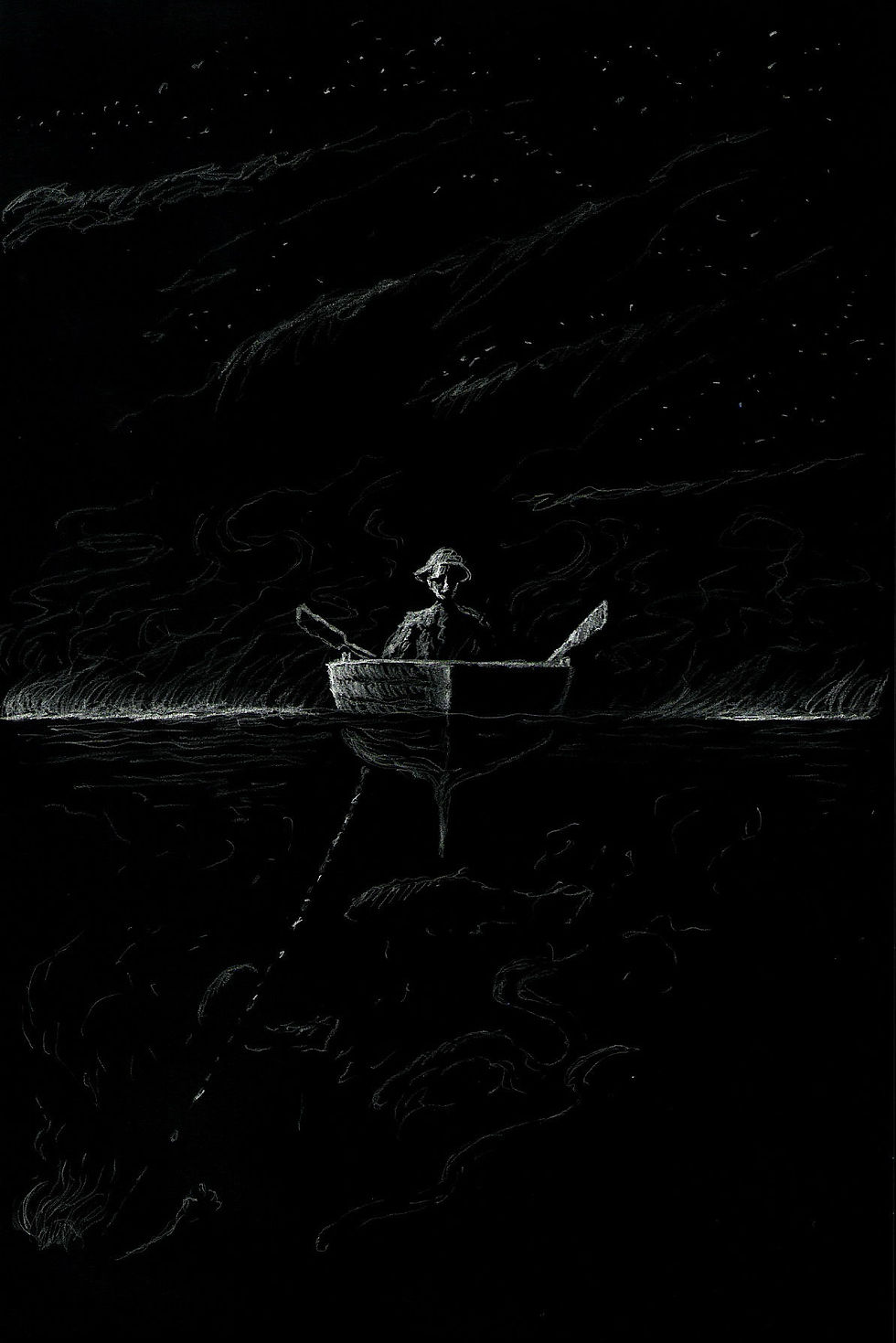
At the time, he frequently rowed at night and was returning home in his large boat after dining with a friend. On a beautiful moonlit evening, he stopped near a reed-covered point and dropped anchor, intending to sit quietly and smoke his pipe. The river was perfectly calm, but its extraordinary silence soon unsettled him. The reeds seemed to move strangely, and when he heard a frog croak suddenly beside him, he shuddered. Unable to smoke or even tolerate the sound of his own singing, he became increasingly nervous.
Then the boat seemed to lurch violently from bank to bank, as though an invisible force were lifting and dropping it. When he tried to leave, however, he discovered that the anchor was stuck. He repeatedly pulled at the chain without success. Eventually he drank some rum and tried to reassure himself that a fisherman would soon come to help him.
Meanwhile, a thick white fog descended over the river. It became so dense that he could no longer see his boat or the water below him. His imagination filled the fog with strange creatures, and he became convinced that something was trying to climb into the boat. Terrified, he contemplated swimming ashore but realized that the fog would probably cause him to become lost and drown.
He tries to reason with himself, observing that “there was something in me besides my will, and that other thing was afraid.” His fear becomes overwhelming, and he remains motionless in the boat, listening for an unknown danger. Eventually he drinks more rum and shouts into the fog for help. Hearing only a distant dog howling, he lies at the bottom of the boat for hours, afraid to move.
At last, the fog clears and reveals an astonishing moonlit landscape. The river shines between enormous walls of fog, while the frogs and bullfrogs awaken around him. He is no longer afraid and eventually falls asleep. When he awakens, however, it is completely dark again, and he becomes frightened once more.
Finally, he sees what appears to be a shadow passing near the boat. He shouts, receives a reply, and discovers that a fisherman has found him. The fisherman helps him try to free the anchor, but it remains firmly caught. Another boat arrives, and together the men finally succeed in pulling it free. Slowly, the anchor rises from the river, “loaded down by a considerable weight.” When they bring it aboard, they discover that it is attached to the corpse of an old woman with a large stone tied around her neck.
ANALYSIS

The river may be seen as a metaphor for the human mind—for mankind’s impulsive, violent, perverted unconscious. Shimmering and inviting on the surface, it harbors a bevy of repulsions in its opaque depths. The jurist in “Diary of a Madman” and the phantom tombstones in “The Dead Girl” deftly identify de Maupassant’s philosophy on Man-the-Social-Animal: we are selfish, violent, egomaniacal beasts girded into staged hypocrisies by the decided-upon performances of our civilization. Murder will not be tolerated, infidelity will be spurned, and suicide seen as madness. But beneath the rippling, reflective exterior of each person’s social self—a two-way mirror which protects the occupant while satisfying and validating the observer—lurks the hidden and hateful things which humanity claims to disown while secretly harboring. The weight of the old woman, whether a suicide or homicide, is immaterial, though either is a possibility; it prevents the narrator from moving forward.
Metaphorically, we may view this as de Maupassant’s claim that once we have encountered the egregious wickedness of mankind, whether knowingly or unknowingly, we will be arrested from practicing our social rituals and performing the masquerade of bourgeois contentment. Unaware of what prevents his movement, the narrator is nonetheless conscious of its predatory nature, and in that moment of realization, the ruse of security is demolished, and in its place stands vulnerable human terror—as stark and exposed as a sheep tethered to a stake in a wild thicket.
II.
The corpse also gives physical form to everything the narrator has sensed without being able to identify. Throughout the story, the river is repeatedly described as mysterious, deceptive, and capable of inspiring fear without revealing its cause. The narrator’s terror initially seems irrational precisely because he cannot point to anything concrete. The discovery of the woman’s body retroactively gives that terror a material object. The river really was concealing something terrible, even though the narrator could not know what it was. This is one of the story’s most effective reversals: what appears to be supernatural dread is suddenly grounded in a brutally physical fact.
Yet the revelation does not make the river less frightening. If anything, it makes the preceding atmosphere more disturbing, because the narrator’s instincts have proved more perceptive than his conscious reason. He senses danger before he knows its source. Maupassant therefore leaves us with an uncomfortable question about the relationship between intuition and rationality. Is the narrator merely imagining threats because he is alone in an unfamiliar environment, or is he responding to something genuinely present? The answer, ultimately, is both. His fears are exaggerated by his imagination, but the world itself contains genuine violence. The mind invents monsters, but it does not invent all of them.
III.
This is also where “On the River” anticipates the later tradition of weird fiction. Blackwood’s “The Willows,” in particular, would similarly transform a seemingly beautiful river landscape into an environment charged with an almost sentient hostility. But where Blackwood tends toward the cosmic and supernatural, Maupassant’s terror remains rooted in human experience. The horror beneath his river is not an alien god or an unknowable dimension. It is a dead human being, perhaps murdered, perhaps self-destroyed, carrying with her the ordinary and terrible violence of human existence. The river is frightening because it conceals the same darkness that civilization conceals: suffering, cruelty, death, and the capacity for violence.
And that may be the story’s final cruelty. The narrator begins by believing that the river is beautiful, peaceful, and familiar. By the end, he has learned that appearances offer no guarantee of safety. The surface may sparkle in the moonlight while something dreadful lies rotting beneath it. For de Maupassant, this is not merely a characteristic of nature. It is a condition of humanity itself. Beneath the polished surface of civilized life lie impulses, crimes, fears, and appetites that cannot be eliminated—only hidden. The river keeps moving, serene and indifferent, while carrying its secrets downstream.