


Guy de Maupassant's The Night: A Nightmare (La Nuit: Cauchemar), Explained: A Detailed Summary and a Literary Analysis

Stripped of Maupassant's confident disdain for society, “Night in Paris: A Nightmare” features, like “Who Knows?,” a protagonist who gets what he wants and pays the price for it. Disgusted by the bustle of daytime, this Parisian delights in the black cover of nightfall, eschewing the company of men for the solitude of darkness. It is a wish fulfillment with a surreal, unsettling consequence. Like “Who Knows?,” “Nightmare” prefigures the works of the Latin American magical realists—who, like many modern short-story writers, were influenced by Maupassant—in its postmodern-seeming atmosphere of existential angst, Sartrean anxiety, and suspended belief.
The story is ostensibly narrated by a dead man, although we cannot discount unreliable narration. Compare its bizarre grotesquerie to Sergio Pitol Bukhara's “Nocturne,” Juan Rulfo's “Luvina,” Julio Cortázar's “Blow-up,” and Jean-Paul Sartre's “Nausea.” Published in 1887, late in Maupassant’s career, the tale belongs to the darker strain of his fiction, where ordinary perception gradually gives way to psychological terror.
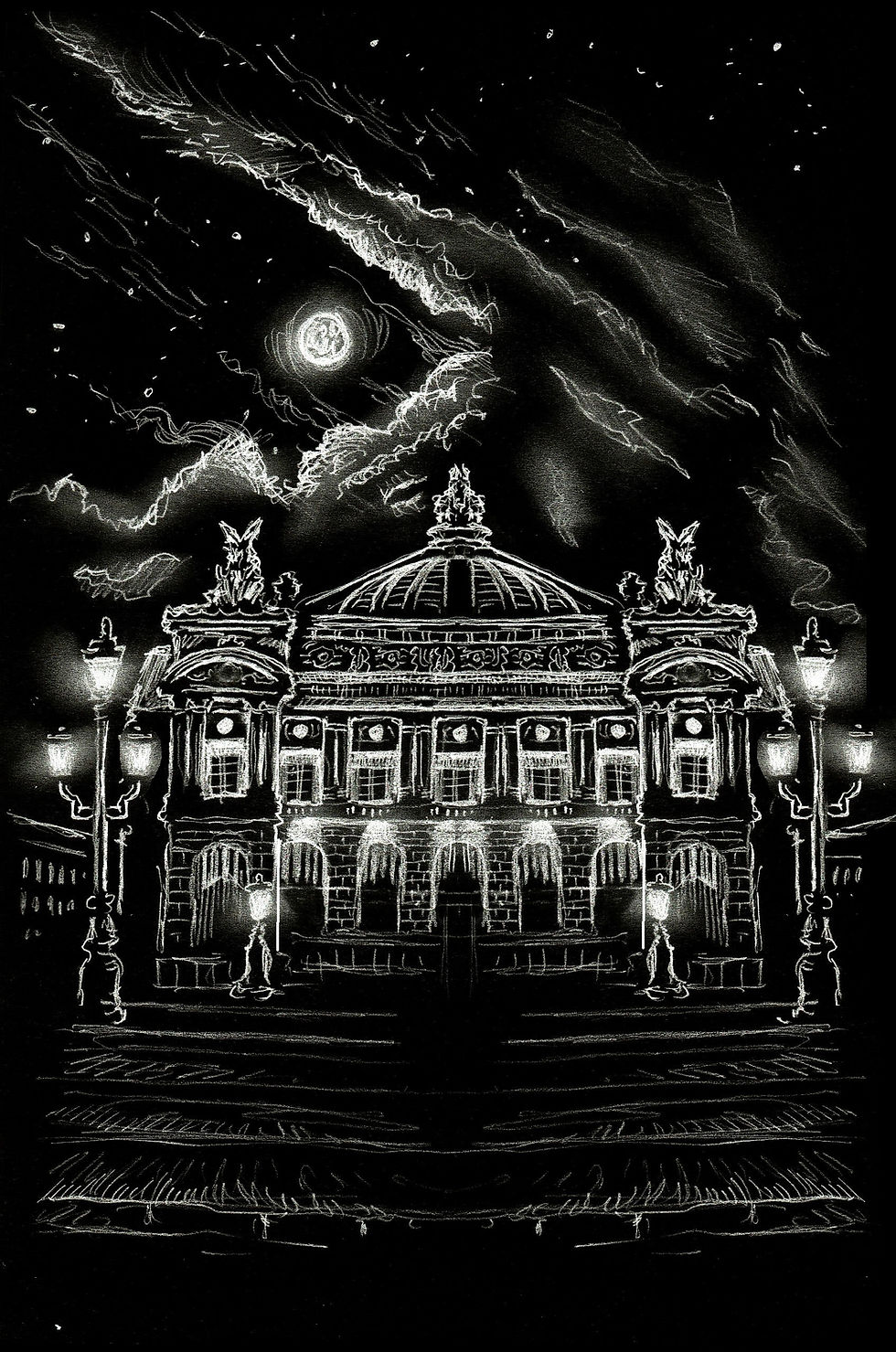
Its Paris is recognizably modern: gaslight, electric illumination, cafés, theaters, boulevards, and the machinery of a city that continues working after its inhabitants sleep. Against that urban brightness, Maupassant sets an increasingly primordial darkness, turning a familiar metropolis into an uncanny wilderness.
SUMMARY

This strange and haunting tale begins with a narrator who expresses an intense, almost sensual love for nighttime. Unlike the day, which he finds “brutal and noisy,” night makes him feel alive, energetic, and joyful. Darkness transforms the familiar world, covering colors and shapes and allowing him to feel connected to the animals that emerge after sunset. He describes night as a time when “a joy swirls about me” and an “impetuous, invincible desire to love” fills his body.
One evening in Paris, the narrator follows his usual nighttime routine, walking through the city after dinner. The night initially appears beautiful and vibrant. He admires the stars above the rooftops, the glowing cafés along the boulevards, and the illuminated Champs-Élysées.
At the Arc de Triomphe, he pauses to admire the avenue stretching into the distance beneath the stars. He then enters the Bois de Boulogne, where he experiences a strange, powerful emotional revelation “which bordered on madness.”
When he returns toward the city, however, the atmosphere has changed. Clouds cover the stars, the streets become increasingly deserted, and the narrator senses that “something weird was going to happen.” At two o’clock, he notices that Paris is unusually empty. The familiar city gradually loses its signs of human activity: cafés close, streets become silent, and even the patrolmen and passersby disappear.
The narrator continues walking, compelled by an unexplained need to move. At the Bastille, he discovers that the darkness has become so complete that even the Column of July is invisible. He encounters only isolated figures—a drunk, a woman begging, and a ragpicker—but each disappears into the darkness. When he asks the ragpicker for the time, the man replies that he has no watch.
Soon, the gaslights unexpectedly go out, leaving the narrator completely lost. He tries to reach the Halles, hoping to find signs of life, but the entire city seems abandoned. He calls for help repeatedly, shouting “Help! Help! Help!” yet his voice produces no response. Even his watch, which had provided comfort through its ticking, eventually stops.
Growing exhausted, hungry, and terrified, he desperately searches for another human being. He rings doorbells and pounds on doors, but nobody answers. Finally, he reaches the Halles and finds it utterly deserted—“empty, motionless, abandoned, dead!”
He becomes overwhelmed by the realization that something extraordinary has happened to Paris.
Unable to determine the time and hearing no clocks, voices, carriages, or other sounds, the narrator reaches the Seine.
He descends toward the water to discover whether the river is still flowing. The water is freezing and strangely lifeless. At the story’s conclusion, he realizes with horror that he may never escape the riverbank and will die from “hunger—from exhaustion—and from cold...”
The night he once adored has become an endless, terrifying nightmare in which the entire world seems to have died.
ANALYSIS
“Anything you love too violently always ends up killing you.” This quote truly embraces the ethos of Maupassant's horror. It is true of most of his horror stories (“Am I Insane?,” “The White Wolf,” “He?,” “The Inn,” “Who Knows?,” “The Dead Girl,” “The Grave,” etc.), and while the death in most of these is spiritual, social, or mental, it is as veritable a destruction of the self as suicide. But the death is manifold in this tale. Whether or not we trust the narrator's account of his watery demise, the fact is that he finds himself destroyed by that which he once loved and cherished.
Though Maupassant famously employed perfidious women to achieve this artistic end, his later stories tended to refocus the theme from external betrayal to internal treachery. Once spiteful of human beings and their accompanying sights and sounds, the narrator is traumatized by their perceived loss and by his inability to attract human fellowship.
Abandoned to the chaos of a world that personifies the characteristics he most cherished about nighttime, he is driven to self-destruction rather than endure a world in which he is incapable of experiencing human relationships—even of the most petty degrees: hearing footsteps and seeing wakeful faces.
Obsession—the all-consuming idée fixe—is initially attractive and desirable, but once it is achieved, once it turns into the embrace, its arms tighten into an inescapable death grip, and its overwhelming weight bears its victim down to the ground. “Anything you love too violently...”
II.
Notably, there is a reversal in the story’s treatment of nature. At first, darkness liberates the narrator from civilization and reunites him with the animal world; later, when darkness becomes total, civilization’s comforts—clocks, lights, voices, doors, and other people—become the things he desperately needs.
The terror therefore lies not simply in isolation, but in discovering that the self he constructed against society depends upon society’s continued existence. His earlier contempt for human company gives the story a moral irony: when everyone disappears, he discovers that even the irritating stranger is companionship.
The narrator’s uncertainty complicates the ending. If his account is literal, he has entered a supernatural void; if distorted, the endless night may represent psychological collapse, exhaustion, or an altered state of consciousness. Either reading preserves paradox: he sought freedom from humanity, only to find that solitude is indistinguishable from annihilation. The vanished city becomes a projection of his life.
III.
The story is also about the collapse of human scale. At first, darkness liberates the narrator because it removes the things he finds oppressive: people, noise, commerce, and artificial light. But as the night deepens, it begins to erase the very structures by which he understands his existence. The cafés disappear, then the pedestrians, patrolmen, clocks, bells, and finally even his watch ceases to tick.
The watch is particularly significant: its tiny mechanism initially comforts him because it provides a surviving fragment of human order, but when it stops, time itself becomes unknowable. The narrator can no longer locate himself within the ordinary rhythms of human life. Even space becomes unstable as he gets lost in streets he knows and must navigate by counting them, while familiar landmarks disappear into darkness.
Maupassant thus turns solitude into something more terrifying than mere loneliness. Without human beings, light, sound, landmarks, and clocks, the narrator loses the external world against which he can measure himself. The story's treatment of light and darkness undergoes a similar reversal.
The narrator initially describes darkness with ecstatic beauty, while artificial light seems brutal, false, and oppressive. Yet when darkness achieves its absolute form—when it has consumed everything—its beauty becomes indistinguishable from annihilation.
He wanted night as an escape from the human world; he gets night with nothing human left to escape from. The horror, therefore, lies not simply in darkness, but in the realization that a world reduced to darkness has ceased to be a human world at all.
IV.
The story's supernatural ambiguity makes this transformation still more unsettling. The narrator repeatedly tries to impose rational explanations on what he encounters: the gaslights have been extinguished as an economy measure, perhaps the city is merely asleep, perhaps the strange silence has some ordinary explanation.
Yet these explanations progressively fail as clocks stop, sounds vanish, doors remain unanswered, and even the existence of the river becomes uncertain. Maupassant never entirely settles whether Paris has literally been emptied or whether the narrator's perception has broken away from ordinary reality.
This ambiguity is important because either possibility leads to the same psychological truth: he can no longer inhabit the world he once wished for. Indeed, the horror may lie precisely in the fact that his wish has been granted too completely. He wanted freedom from humanity, darkness, and solitude, imagining them as positive experiences because they existed in contrast to the society he despised.
But once those conditions become absolute, he discovers that his own identity depended upon the very human world he rejected. His tragedy is therefore not simply that he is alone, but that he has discovered too late that solitude is meaningful only in relation to fellowship, and darkness beautiful only because there is still light.
The story consequently transforms what begins as a romantic celebration of nocturnal freedom into something closer to an existential nightmare: the individual who wishes to escape the world discovers that escaping the world may also mean escaping the conditions that make his own existence comprehensible.