


Reviewing: Diana Peterfreund's Ellen Poe - The Forgotten Lore

There is always a danger in writing a new story around Edgar Allan Poe. His name carries such a distinctive atmosphere that it is easy to reduce him to a handful of familiar images: a raven, a dark room, a mysterious death, a beautiful but doomed woman, and perhaps a conveniently sinister-looking black cat. A story can sprinkle these ingredients liberally over its pages without having much to do with Poe himself.
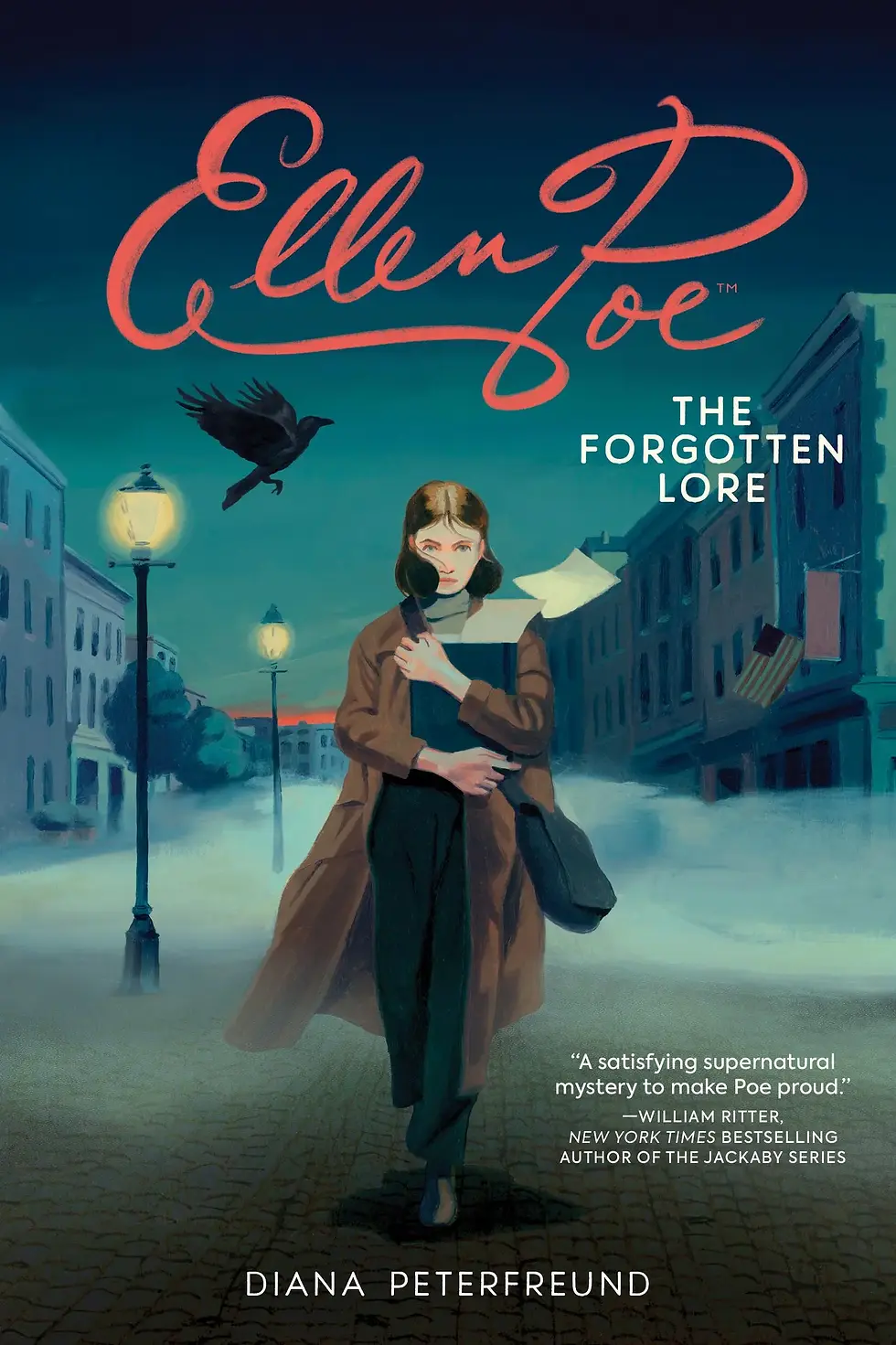
Diana Peterfreund's Ellen Poe: The Forgotten Lore takes a considerably more imaginative approach. This young adult supernatural mystery (published by is unmistakably a Poe-inspired adventure, but it is also a surprisingly effective introduction to the writer's life, work, and peculiar fascination with codes, puzzles, secret messages, and the macabre. Best of all, Peterfreund manages to incorporate all of this into the actual machinery of her mystery rather than treating Poe's biography as background decoration.
Sixteen-year-old Ellen Poe Reynolds has grown up with the family tradition that she is descended from Edgar Allan Poe. The connection becomes considerably more interesting when Ellen moves to Baltimore to live with her aunt Marie, who runs a struggling Poe-themed bed-and-breakfast. The house is filled with Poe memorabilia and lore, but Ellen has more immediate concerns. She has been plagued by disturbing nightmares for years, and after arriving in Baltimore, those nightmares begin to intrude upon her waking life.
Then she discovers a mysterious journal containing cryptograms, drawings, poems, and other strange material. Before long, Edgar Allan Poe himself begins appearing to her.
The obvious question is whether Ellen has somehow released Poe's ghost—and, more importantly, what the ghost wants from her. As Ellen begins following his cryptic clues, she discovers that her connection with Poe may be more significant than she imagined. Her investigation draws in her new friend Gus, her increasingly mysterious family history, and a series of puzzles that lead deeper into Poe's life and writings.
It is an excellent premise for a young adult mystery, but what makes The Forgotten Lore particularly enjoyable is how thoroughly Peterfreund commits to the Poe material.
The book is packed with genuine Poe lore. His stories and poems are not merely mentioned for the sake of giving the novel a Gothic flavor; they become part of the mystery itself. Cryptograms, substitution ciphers, hidden messages, literary clues, and details from Poe's life all contribute to Ellen's investigation. The result sometimes feels almost like a literary scavenger hunt, in which knowing something about Poe gives the reader another piece of the puzzle.
That makes the book an especially clever introduction to Poe for younger readers. Someone who comes to The Forgotten Lore knowing little more about him than The Raven and The Tell-Tale Heart will encounter a much fuller picture of the writer. And because the information is embedded in an adventure rather than presented as a biography lesson, it rarely feels like homework. Readers learn about Poe because Ellen needs to know it, and because they want to solve the mystery alongside her.
Even readers who already know Poe will find plenty to appreciate. Peterfreund's affection for her subject is evident throughout the novel, and she clearly understands that Poe was considerably more interesting than the gloomy caricature that has sometimes grown up around him. His fascination with cryptography, in particular, proves a wonderfully appropriate foundation for the story.
Poe really was interested in secret writing and puzzles, so turning those interests into the mechanisms of a supernatural mystery feels much more satisfying than simply borrowing his name and aesthetic.
***
One of the book's most charming touches is the characterization of Poe's ghost. Rather than having a modern author invent an entirely new personality and put contemporary dialogue into Poe's mouth, Peterfreund draws extensively upon Poe's own writing. This gives the ghost an appropriately strange, literary voice while allowing the real Poe to remain present beneath the fictional conceit. It is a clever way of bringing a nineteenth-century writer into a contemporary YA adventure without making him feel completely detached from the person who actually lived and wrote.
The setting helps considerably as well. Baltimore is an ideal location for this kind of story, and the Poe-themed bed-and-breakfast provides just the right mixture of eccentricity, history, humor, and Gothic atmosphere.
There are cobwebs and ghosts and nightmares, but the novel never seems determined to make everything relentlessly grim. Peterfreund understands that a good supernatural mystery can be spooky without becoming oppressive.
That balance between creepy and playful is one of the book's strengths. The Forgotten Lore has genuine darkness at its edges, but it is ultimately an adventurous mystery rather than a horror novel. The puzzles keep the story moving, while Ellen's perspective and the supporting characters provide warmth and humor. The result should work particularly well for readers who enjoy mysteries with a supernatural element but don't necessarily want something genuinely terrifying.
Ellen herself is an appealing center for the story. She is intelligent and resourceful, but she is not simply an impossibly competent teenage detective who happens to possess all the answers. Much of the story involves her trying to understand experiences that frighten and confuse her, while simultaneously dealing with the ordinary difficulties of being sixteen. Her growing willingness to investigate rather than simply fear what is happening to her gives the supernatural plot a satisfying personal dimension.
The book also understands one of the pleasures of a good puzzle mystery: the reader should have the opportunity to play along. As Ellen begins deciphering clues and connecting pieces of Poe's history, the story invites us to wonder what the clues mean and where they are leading.
The puzzles aren't simply decorative references to Poe's reputation as a writer interested in cryptography; they are part of the adventure.
***
Readers should be aware that The Forgotten Lore is very much a young adult novel. Its storytelling is accessible and straightforward, and some passages favor explanation over the sort of subtlety one might expect from a more mature Gothic novel. The story also occasionally slows down before gathering momentum again. Those qualities may be more noticeable to adult readers, particularly those accustomed to darker or more psychologically complex supernatural fiction.
But accessibility is hardly a defect when it is part of the book's purpose. Peterfreund is writing a mystery that can introduce a new generation to Poe, and she has found a particularly entertaining way to do it. In fact, one of the pleasures of the book is imagining a young reader finishing it and then deciding to pick up The Raven, The Gold-Bug, The Cask of Amontillado, or one of Poe's other stories to see how the pieces fit together.
And that may ultimately be the greatest achievement of Ellen Poe: The Forgotten Lore. It does not merely use Edgar Allan Poe as a convenient Gothic mascot. It makes his actual life and literature part of the fun.
The result is a charming, atmospheric, puzzle-filled supernatural mystery that should appeal both to young readers discovering Poe for the first time and to longtime Poe enthusiasts who enjoy seeing familiar material approached from an unexpected direction. There are ghosts, nightmares, secret messages, family mysteries, cryptograms, literary clues, and a distinctly Poe-esque sense that the past has a way of refusing to stay buried.
For readers who enjoy Gothic mysteries, historical puzzles, supernatural adventures, or classic literature with a contemporary twist, Ellen Poe: The Forgotten Lore offers an unusually winning combination. It is spooky without being excessively frightening, literary without becoming stuffy, educational without feeling instructional, and clever without losing sight of the simple pleasure of solving a mystery.
Most importantly, it leaves the reader with something that the best literary adaptations and homages often accomplish: a renewed curiosity about the original. If The Forgotten Lore (which you can find here, on Amazon or here, from Bookshop -- and you can preorder Book Two, Ellen Poe: For Evermore, here!) sends a young reader—or an adult reader, for that matter—back to Edgar Allan Poe's own stories with fresh interest, then Peterfreund has done considerably more than write a novel about Poe's ghost. She has found a lively new way to invite readers into Poe's world.