


Sympathy and Haunting in Nineteenth Century Scottish Ghost Stories: A Lecture Given to the House of Burnett

The following lecture was presented to and recorded for the House of Burnett for the Halloween-themed October 14th symposium. The House of Burnett is a non-profit international Scottish heritage association dedicated to cultivating its members into a community interested in geneology, history, culture, and ancestry related to the Burnett Clan and to Scottish culture writ large.
I was invited a whole year in advance by my friend and correspondent, Valerie D'Aguanno -- who clearly knows how to snag speakers, who can of course be wishy-washy, leaving them with no excuse for declining -- to do a presentation on the classic Scottish ghost story tradition, which gave me a long time to ponder the topic.
Unlike the Irish, English, or American forms, the Scottish contributions to the classic era of supernatural fiction (ca. 1789 - 1939) was remarkably sparse: only about 10 major figures, roughly 50 total of any significance, during that 150 year period. However, among the chief figures, I recognized a recurring theme from when I wrote my Master's thesis on the influence of the Scottish Enlightenment on the political parables of early American fiction (“Sympathy Unites, Whom Fate Divides”: Scottish-Enlightenment Dialectics of Nationhood in The Power of Sympathy’s Republican Parable, December 2012, Ball State University): the role of sympathy as a catalyst for moral restitution, social reconciliation, and spiritual restoration.

While Irish ghost stories (cf. Le Fanu, Stoker, Riddell) tend to hinge (understandably...) on revenge and English ghost stories (cf. James, Nesbit, Jacobs, Benson) tend to hinge (understandably...) on guilt, Scottish ghost stories -- what few there are -- have a tradition of exploring intentional acts of face-to-face reconciliation (also perhaps understandably...) which enlist the potent power of sympathy (what Adam Smith called fellow-feeling) in order to enact spiritual justice.
I had a wonderful time with the House of Burnett -- they are a lovely group -- and I am excited to share the text of my leacture for any of you who may be curious about the great beating heart that forms the emotional and moral core of Scottish supernatural fiction: the premise that through the sincere and attentive employment of empathic imagination we can transform heaven and earth...
SYMPATHY AND HAUNTING IN
NINETEENTH CENTURY SCOTTISH GHOST STORIES
I.
Introduction:
What Does a Ghost Want?
Firstly, thanks so much for coming to this talk! I hope you’re all having a cozy spooky season and I hope this adds to your Halloween fun this year. The three stories we’ll be looking at are fantastic examples of the Scottish Victorian ghost story genre and I’d definitely recommend reading them for yourself.
As we begin this journey into the distinct moral architecture of classic, Scottish spook stories, let’s start this off with a pretty basic question: “What do ghosts want?”
If you’ve read enough ghost stories, you might think the answer is usually straightforward. Supernatural visitors arrive for one of three basic reasons: restitution, self-recognition, or manifested anxiety.
In tales of restitution or revenge – found in The House of Seven Gables, “The Familiar,” and “The Ash-Tree” – someone’s been murdered, betrayed, cheated, or otherwise wronged, and now the dead person has returned to settle the score or guide the scales of justice.
In tales of self-recognition – such as A Christmas Carol, The Turn of the Screw, or “Count Magnus” – the haunter is a reflection of the haunted, and their increasing proximity leads to awareness of the haunted’s unacknowledged darkness – the ghost within.
In tales of manifested anxiety – famously illustrated in “The Legend of Sleepy Hollow,” “The Signal-Man,” and “Man-Size in Marble” – the haunter represents a critical personal insecurity that confronts the haunted, materializing these repressed anxieties.
There’s nothing wrong with these sorts of ghost stories. They’re among the oldest, most effective ways to use a ghost in exploring the human condition. The dead return because either A. something has been done to them, B. they’re psychological identities who’ve been ignored, or C. because they’re expressions of unfaced fears – and the living must navigate the consequences.
The classic English-language supernatural tale flourished from roughly 1850 to 1915, exemplified in the trajectory from Elizabeth Gaskell’s “The Old Nurse’s Story” to the darker weird fiction of E. F. Benson’s “The Room in the Tower.” This period, loosely corresponding to the Mid-to-Late Victorian and Edwardian eras was dominated by English-language writers like Charles Dickens, Ambrose Bierce, Amelia B. Edwards, Henry James, J. Sheridan Le Fanu, M. R. James, and Charlotte Riddell.
In England, Ireland, and America – where the genre thrived – these three themes—avengers, doppelgangers, and boogeymen—were central to the form. However, in Scotland – where literary ghost stories were fewer and the genre subtler – something quite different characterized them.
In Margaret Oliphant’s “The Open Door” – distinct from the same-titled tale by Irishwoman Charlotte Riddell – the ghost isn't trying to frighten or punish anyone. He seems to be a miserable, confused boy who simply needs someone to understand what happened to him.
In Robert Louis Stevenson’s “The Body-Snatcher,” the situation’s reversed. The men have deliberately stopped thinking of the dead as people. They see corpses as objects—commodities for study—and the horror climaxes when one of those bodies returns as a person they can no longer dehumanize or objectify.
And in Arthur Conan Doyle’s “The Brown Hand,” the ghost has a specific problem: he wants his amputated hand restored to him, but isn’t being taken seriously. Once the living understand what he wants and give it to him, the haunting ends.
These are each very different stories, and I don't mean to suggest they have the same meaning. But they share an idea about what happens when the living encounter the dead.
The important question isn't “What is this?”
It's “Who is this?”
Then, once we recognize the ghost as a person: “What has happened to him, and what does he need?”
I’d suggest the answer has something to do with a very Scottish idea: sympathy, or fellow-feeling.
By sympathy, I don't simply mean pity. I'm using it in the older Scottish Enlightenment sense, particularly Adam Smith’s: the imaginative act of putting ourselves in another person's situation.
These ghost stories turn that moral and psychological process into something supernatural.
Normally, sympathy requires crossing an imaginative boundary. We can't experience another person's suffering, so we imagine ourselves in her position.
But what if that person crosses the boundary himself?
The dead person comes back.
Once he's standing before us, the problem is no longer imagining what he experienced. We have to respond.
My argument is that, in these three Scottish ghost stories – showcases of Scotland’s unique horror tradition in the Victorian Age – sympathy functions almost like a supernatural force: a distinctly Scottish haunting shaped by Scottish philosophy, politics, and history. It can make the dead person’s experience present; and once recognized and answered, it can allow the dead to leave in peace.
These ghost stories are not about defeating the supernatural, but recognizing the humanity within it.
I'll begin with Adam Smith's account of sympathy, then look at Oliphant, Stevenson, and Doyle—as examples of “successful sympathy,” “failed sympathy,” and “creative sympathy,” respectively, within the framework of Scotland’s Enlightenment ideals.
II.
"What Has Befallen You?":
Sympathy and the Scottish Enlightenment

Before turning to the stories, let’s unpack this more philosophical use of the word “sympathy,” because it helps explain something distinctive about the Scottish ghost story.
Today, sympathy usually means pity or compassion. But that isn't exactly what eighteenth-century Scottish philosophers meant when they used the word. For them, sympathy was a more active, imaginative process.
Adam Smith gives us the clearest account. In The Theory of Moral Sentiments, he argues that we have no direct access to another person’s feelings. If somebody’s suffering, I can't experience his pain; I can imagine what I'd feel in his situation. As Smith puts it [quote] “we can form no idea of the manner in which” another person is affected except by imagining what we ourselves would feel in the same circumstances.
Smith makes an important distinction. Sympathy doesn't arise simply because we see somebody expressing an emotion. If we hear somebody crying in distress without knowing why, we ask, [quote] “What has befallen you?” We want to understand the situation producing the emotion. For Smith, sympathy depends on imaginatively reconstructing another person's circumstances.
This is where things get interesting for ghosts.
Smith says early in The Theory of Moral Sentiments: “We sympathize even with the dead.”
He describes how we picture the dead as deprived of sunlight, conversation, friendship, and memory. Smith knows the dead don't experience these things. But we imagine their condition as if we were in it, [quote] “lodging” our living souls in their inanimate bodies.
Sympathy, in this sense, is an act of imaginative crossing. I remain myself, but try to enter another person's situation and understand an experience that isn't mine.
Smith wasn't working in isolation. David Hume had already made sympathy central to his account of human nature, describing it as a process through which one person's feelings are communicated to another. Another person's emotion can become, through sympathy, something like an emotion in ourselves. This emphasis on sympathy, fellow-feeling, and sociability runs through eighteenth-century Scottish moral philosophy.
That gives us a useful way of looking at these ghost stories.
What if imaginative sympathy becomes supernatural?
What if the person whose experience we can only imagine crosses that boundary?
The Scottish ghost story seems particularly interested in that possibility. Again and again, we encounter a dead person whose experience remains inaccessible: someone who’s suffered, lost something, been wronged, or simply hasn't been understood. The ghost's appearance makes that experience present.
So in these stories, sympathy isn't simply a moral virtue. It becomes part of the supernatural machinery.
Sympathy can manifest the dead's experience. When the living understand and respond to that experience, sympathy can release the dead.
And I think Margaret Oliphant's “The Open Door” gives us perhaps the clearest place to see that process at work.
III.
Margaret Oliphant’s “The Open Door”:
Sympathy as Exorcism

Her tale begins with a familiar ghost-story problem: there is something outside the narrator’s house, roaming the adjacent remnants of an older manor, weeping at the ruins of a forgotten stone doorway. Night after night, an anguished voice cries from the crumbled lodge. But no one can determine what it is. Is it a person, an animal, an acoustic trick, or a supernatural presence?
The story gradually shifts the problem.
At first, the question is what is it?
Eventually the more important question becomes:
Who is it?
That shift happens largely through Roland, the narrator’s young son. Roland hears the voice and, rather than primarily fearing it, becomes obsessively concerned about whatever—or whoever—is suffering outside. Indeed, Roland’s empathy is so strong that he begins to sicken and die, inspiring his pragmatic father to seek a practical solution to what he originally dismissed as a sensitive boy’s fancy. When his father tries to dismiss the phenomenon, Roland cries out, “Oh, think, papa—think if it was me!”
That simple sentence is almost a miniature of the sympathetic imagination I described. Roland's response is: put yourself in its place.
That changes the nature of the haunting.
The narrator eventually experiences it himself. He hears the cry, sees the figure, and rather than treating the apparition as an inexplicable object, concludes:
[quote] “I knew the creature, and it was in trouble.”
That sentence is the key to the story.
He doesn't say, I knew what it was.
He says, I knew the creature.
More importantly, he understands its condition: it was in trouble.
The ghost becomes intelligible not when the narrator discovers its physical explanation, but when he recognizes its human situation.
Oliphant's story closely resembles Adam Smith's moral psychology. Smith says that when we encounter suffering, our first impulse is to ask, “What has befallen you?” We need to understand the situation behind the emotion. In “The Open Door,” that's what the characters are compelled to do.
As the tale progresses, the narrator employs three friends who bring three approaches to the conundrum. First is his manservant, a fellow army veteran, whose bravery and stiff-upper-lip attitude fail to dislodge the ghost, ultimately leading to his undoing and resignation after the traumatic encounter. Secondly, the family doctor – a proud skeptic – wields science and logic against the phantom voice without effect, returning baffled but emotionally untouched, eventually rationalizing away his experiences. Bravery and intellect aren’t enough to rescue the poor soul. The story's crucial act of sympathy comes from Dr. Moncrieff, an open-minded, emotionally-intelligent Presbyterian minister.
Moncrieff doesn't approach the apparition as an abnormal phenomenon to explain or drive away. He recognizes it as Willie, a young man he once actually knew. He speaks to him, asks him why he's returned, and wonders why he's frightened people who don't understand him.
That distinction is crucial.
Moncrieff doesn't come to exorcise a ghost.
He comes to speak to a person.
Once recognized as Willie, the ghost’s behavior becomes intelligible. He isn't haunting the house because he's evil or wants revenge. He's a miserable, confused spirit attached to the place and his mother's memory, haunting a doorway without a door, begging to be let inside a passage that has no barrier save the one in his own guilty conscience – an open door, indeed.
Moncrieff explains that his mother is dead and urges him to turn from the ruined earthly doorway toward the heavenly gates where reconciliation awaits him. In spite of his Presbyterian background, the old man prays for his soul, and the ghost disappears. The next morning, Roland has recovered, and peace returns to the narrator’s world.
So what happened?
The ghost wasn’t defeated.
It wasn't threatened, banished, or overpowered.
It has simply been understood.
Understanding makes consolation possible.
This gives us what I think is the first major version of the pattern I'll be tracing through these stories:
Sympathy makes the ghost intelligible; recognition makes consolation possible; consolation permits peace.
The ghost is both manifested and exorcised through this process.
The more the living enter the ghost's situation, the more fully the ghost comes into view. An unexplained cry becomes a recognizable person. The supernatural presence becomes more definite as sympathy increases.
But once that person has finally been understood, the haunting ends.
So sympathy works in two directions.
It first conjures the dead by bringing their experience into consciousness and physical manifestation.
It then exorcises the dead, because, once recognized and answered, the dead person no longer needs to remain.
“The Open Door” therefore gives us a ghost story in which the dead person's claim isn't fundamentally a demand for justice. The ghost doesn't return because he wants someone to suffer. He returns because something in his experience remains unresolved and unrecognized.
The living person must imaginatively cross the boundary between himself and the ghost.
And once he does, the ghost can finally cross back.
IV.
Robert Louis Stevenson's "The Body Snatcher":
The Haunting Produced by Failed Sympathy

Robert Louis Stevenson gives us a much darker version of the same problem. If “The Open Door” shows what happens when sympathy succeeds, “The Body-Snatcher” asks what happens when sympathy is deliberately suppressed.
The callous anatomy-student FETT-IS, the story’s central character, has learned not to concern himself with the lives and deaths of others. He works in a medical world where the dead are increasingly treated not as persons but as tradable objects—acquired, transported, dissected, and studied. Valuable corpses are sold to Fettes’ superiors under the table by grave robbers, often under suspicious circumstances.
That becomes a problem when Fettes recognizes one of his professor’s recent acquisitions: Jane Galbraith, a young woman who was perfectly healthy yesterday, and whose new bruises make him suspect she’s been murdered. Stevenson describes the electric change in the heretofore cold-blooded Fettes when his eyes [quote] “lighted upon the dead face” and recognized its identity. The body is no longer an anonymous specimen. It is Jane Galbraith.
That moment matters because the face is where the object becomes a person. Fettes can treat an unidentified corpse as a thing; it’s harder when he sees someone he knew. Sympathetic recognition briefly breaks through the professional stoicism of the dissecting room.
But his older, more cynical colleague, Macfarlane, persuades him to suppress that sympathy. He has a proto-Nietzschean philosophy for doing exactly that. He divides the world into “lions” and “lambs”: the strong survive by preying upon the weak, while those who allow themselves to sympathize eventually become victims themselves. His advice is essentially: don’t imagine what it would be like to be the person on the table, lest you join them.
So, if Rolland gives us the sympathetic imagination—
“Imagine yourself in their place”—
Macfarlane gives us its opposite:
“Actively train yourself not to think about them as a person at all.”
The horror of the story grows from that refusal. Fettes allows himself to become morally numb, accepting Macfarlane’s warped vision even as his misgivings build. One night, Macfarlane introduces Fettes to his crude acquaintance, Gray, who knows some of Macfarlane’s darkest secrets. Macfarlane subsequently murders Gray to escape blackmail and delivers the corpse to Fettes for dissection and disposal, which is promptly done.
Weeks later, on a rainy night, Fettes and Macfarlane travel to a country churchyard to exhume the body of a freshly buried farmer's wife. During their drive back, the horses grow terrified by an unsettling change in the ghoulish cargo: the covered female corpse now appears to be that of a man. Shaken, Macfarlane declares in spite of himself, [quote] “I must see her face.” When they light a lantern to inspect the canvas sack, they discover that the woman's body has supernaturally transmorphed into the long-ago-dissected corpse of Gray.
Years later, Stevenson gives us a final face-to-face encounter. Fettes, now a ruined alcoholic, meets Macfarlane again at his favorite bar. When told that the stranger stopping for a drink is the famous Dr. Macfarlane, Fettes declares – also in spite of himself – that he [quote] “must see him face to face.” When the two men stare at each other, silently acknowledging their sordid history, Fettes stumbles into the night, as rattled by Macfarlane’s social and professional success and lack of shame as he was by the uncovered faces of the murdered Galbraith and Gray.
These three moments of recognition give the story its moral structure. First, Fettes sees Jane’s face and his conscience awakens. Then he sees Gray’s face and breaks from Macfarlane’s influence, though – importantly – without exposing him. Finally, he confronts Macfarlane himself, face to face, and recognizes the folly of his indifference.
Stevenson does not make this a story of easy redemption. Fettes’s recognition comes too late to restore what he has lost. His life has already been damaged by his complicity. Sympathy awakens his conscience, but it cannot undo the past.
In Oliphant, sympathy recognizes suffering and helps release the dead. In Stevenson, sympathy is suppressed, and the dead return as persons whom the living can no longer avoid recognizing.
The medical question is: What is this body?
The sympathetic question is: Who was this person?
And this is where Stevenson’s horror begins: when the first question replaces the second. His ghosts force the second question back into view.
And that brings us to Arthur Conan Doyle, where we get perhaps the most explicit version of the idea: a ghost whose persistence depends upon an unfulfilled human need, and whose release depends upon the living finally understanding – and sympathizing with – what that need is.
V.
Arthur Conan Doyle’s “The Brown Hand”:
Sympathy as Conjuration and Release

The “Story of the Brown Hand” concerns Sir Dominick Holden, a British surgeon who’s spent years working in India. Among his patients is an Afghan man whose right hand had to be amputated. Holden kept the hand as a specimen, and the patient told him something he initially dismisses patronizingly: according to his religious beliefs, his body members need to be reunited after death. In short, he'll eventually be needing his hand back.
A thoroughly secular materialist, Holden doesn't take the warning at all seriously. Eventually the hand is destroyed in a fire, and after the patient's death, his ghost begins to appear in Holden’s laboratory, examining his anatomical specimens. Night after night, the apparition comes looking for what he’s lost.
And again, what's striking is what the ghost doesn't want.
He doesn't come back to punish Holden.
He doesn't demand revenge.
He wants something very specific: the restoration of his hand.
That makes the haunting less an act of vengeance than an unresolved claim and a bid for being witnessed and understood.
The story then gives us something unusually explicit. Hardacre, the narrator, consults a book about the occult and finds a theory that spirits can remain attached to the material world because of powerful emotion or unfulfilled desire. The forces that can hold a spirit here include [quote] “love and pity,” as well as revenge and anxiety. And the spirit may depart once its desire is fulfilled.
In other words, Doyle gives us a supernatural theory remarkably close to the pattern we've already seen.
A sympathetic relationship can both bring the dead into contact with the living, and eventually dissolve that connection.
So, if that relationship is properly understood, the haunting can end.
Hardacre therefore doesn't approach the ghost by trying to drive it away. He tries to figure out what it wants.
That distinction is important.
He isn't asking, How do I get rid of this thing?
He's asking, “What would satisfy this person?”
He obtains what he thinks is a comparable hand – though not the destroyed original – and presents it to the ghost. But the ghost rejects it violently. Hardacre has misunderstood the problem. The hand wasn't the right one (literally: he accidentally brought a left hand). He tries again – respectfully – offers the spirit a comparable right hand, and finally succeeds.
And the response is strikingly different.
The ghost smiles. He raises both spectral hands in a salaam of farewell – spiritually if not physically restored in death – before his apparition disappears forever.
So here we get the two sides of the argument together.
Sympathy conjures, and sympathy exorcises.
Hardacre has to imagine the dead man's situation. He has to take seriously a belief he initially dismissed and reconstruct what the dead man wanted and why it mattered to him.
Once he does that, he can satisfy the claim that has kept the ghost in the world.
And there's another detail that brings us back to the question of science.
Hardacre begins the story as a rational investigator. He's fascinated by the possibility of a genuine apparition and wants to observe it carefully. He approaches the supernatural like a good scientist confronting an unexplained natural phenomenon.
But observation alone doesn't solve the problem.
He can establish that the ghost exists. What he can't establish through observation alone is what the ghost desires.
For that, he needs something closer to sympathy.
He has to move from asking “What is happening?” to asking “What has befallen this person?”
That brings us back to Adam Smith's distinction. Sympathy requires us to imagine another person's situation rather than simply observing his outward behavior. And in “The Brown Hand,” that imaginative reconstruction allows the supernatural mystery to be solved.
The ghost isn't a puzzle to be defeated.
He's a person whose experience has not yet been properly understood.
And once that experience is understood, the supernatural encounter becomes almost peaceful. The ghost gets what he came for, offers his farewell, and disappears.
***
So, taken together, our three stories give us three variations on the same basic principle.
In “The Open Door,” sympathy recognizes suffering, and recognition releases the dead.
In “The Body-Snatcher,” sympathy is suppressed, the dead are reduced to objects, and the dead forcefully return to be witnessed.
And in “The Brown Hand,” sympathy reconstructs the desire of the dead and allows that desire to be fulfilled.
The stories aren't identical, and I don't want to pretend they are. But they repeatedly make the same moral question central:
Can the living imagine the experience of the dead?
And when they can, something changes.
The ghost becomes understandable. Its claim becomes answerable. And, very often, it can finally leave.
VI.
Conclusion:
What Does a Ghost Want?
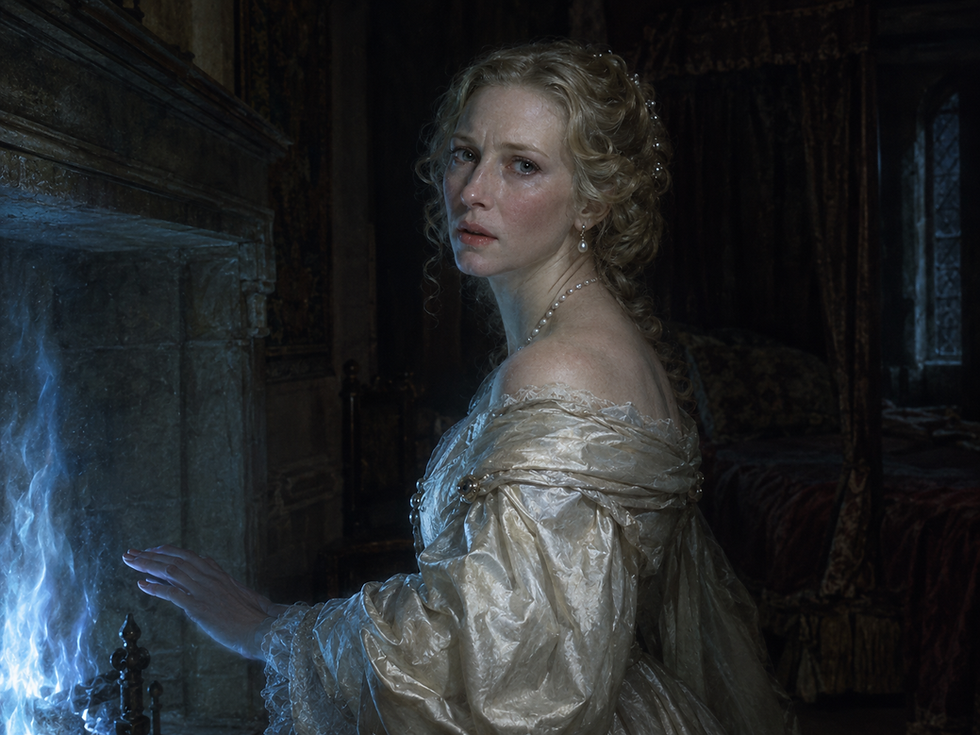
So, let’s wrap this up by returning to the question I started with: what do ghosts want?
The conventional answer was usually that they functioned as agents of either revenge, self-recognition, or anxiety – as avengers, doppelgangers, or boogeymen. And certainly, plenty of excellent stories work that way.
But during the peak of the era of classic ghost stories, many Scottish writers of the form shared a unique perspective on what a ghost can represent to the living. Their ghosts often aren’t primarily interested in punishing wrongdoers or helping the living confront their inner demons. They have the deeply human need to be heard and recognized.
In all three of the stories we examined, the important question isn't simply “What is this?” It's “Who is this?” And then – after the philosophies of the Scottish Enlightenment – “What has happened to him, and what does he need?”
That brings us back to Adam Smith's idea of sympathy: the imaginative movement toward another person, asking, in effect, What would this be like if it were happening to me?
The Scottish ghost story makes that imaginative process literal.
The person whose suffering we would ordinarily have to imagine crosses the boundary between imagination and reality and appears before us. The ghost is, in this sense, the return of the deceased person whom sympathy failed to reach in life.
And this gives sympathy its double function.
It conjures the dead because it makes an absent person's experience present to us. But it also exorcises the dead because, once that experience has been recognized and answered, the ghost no longer needs to remain.
Sympathy makes the ghost intelligible.Recognition makes consolation possible.And consolation makes departure possible.
I’ve suggested a contrast between this and some English, American, and Irish traditions, where supernatural encounters more often turn on revenge, guilt, or anxiety. I don't mean that as an absolute division—there are obvious exceptions—but I do think there’s something distinctive in the Scottish emphasis on fellow-feeling: the idea that the dead may remain among us not simply because they have been wronged, but because their experience has not yet been understood.
And perhaps that gives us a different way of thinking about the Victorian ghost story.
The ghost isn't necessarily the return of evil.
Sometimes, it's simply the return of a person.
And what finally puts the ghost to rest isn't violence, ritual, or even knowledge of the supernatural.
It is the moment when somebody finally understands what it means to have been that person.
Thank you for your time, and I truly hope you’ve enjoyed this peek into three of my own favorite Victorian ghost stories.