

Top 31 Classic Spooky Poems to Read on Halloween Night

The Gothic poem occupies a rather special place in the literary imagination. Where the Gothic novel can take its time ushering us through a creaking door, down a candlelit corridor, and into the room where something terrible has happened, the Gothic poem has other means at its disposal.

A few lines of balladry, a rhythm like approaching hoofbeats, a moonlit landscape, or a refrain that grows more disturbing with every repetition can conjure an entire haunted world. Poetry is especially well suited to Halloween because it thrives on suggestion. It gives us just enough to awaken the imagination, then leaves us alone with what we have imagined.
Ten years ago we released our own anthology of 84 Classic Spooky Poems for Halloween Night and it's been a hit since publication precisely because there is something uniquely compelling about the delicate marriage between our higher and lower impulses -- between the lyrical elegance of a well-crafted poem and the middle-of-the-night unease of an unintelligible fear. This is the zone in which Gothic sensibilities have always excelled: beautifully blending artistry and animalism, intellect and instinct, elegance and decadance.

The 31 poems that follow represent this rich tradition from the 1770s through the 1920s. They are not all horror poems in the narrow sense, nor are they all masterpieces of the same kind. Some offer genuine frights; others are beautiful, melancholy, grotesque, or deliciously strange.
What unites them is their ability to make the familiar world feel momentarily unfamiliar. Read them aloud, preferably after sunset. The old Gothic poets understood that a poem is not merely something to be read but something to be heard, and that the human voice, given the right words and the right darkness, can be a remarkably effective instrument of enchantment.
1. “Lenore” — Gottfried August Bürger (1773)

If Gothic poetry has a founding masterpiece of supernatural speed, Bürger's “Lenore” is a strong candidate. Its heroine, distraught after her beloved Wilhelm fails to return from war, rails against heaven until a mysterious rider arrives in the night, promising to carry her to him. Their ride through the darkness is one of the great set pieces of early Gothic literature: the galloping rhythm, the increasingly macabre landscape, and the rider's unnerving impatience propel the poem toward its dreadful revelation.
Bürger helped establish the supernatural ballad as a distinctly modern literary sensation, and his poem inspired translations, imitations, and adaptations throughout Europe, including works by Walter Scott and others. It also helped shape the Romantic fascination with the undead lover, a figure who would recur in vampire fiction and Gothic romance for generations.
“Lenore” is ideal Halloween reading because it combines the pleasures of a ghost story with the breathless momentum of a nightmare. Its horror is not simply that the dead return, but that grief may make their return seem worth any price.
2. “The Erl-King” — Johann Wolfgang von Goethe (1782)
Goethe's “The Erl-King” distills supernatural terror into a desperate nocturnal journey: a father rides through the storm with his feverish child, who insists that an alluring, invisible figure is calling to him from the darkness. The father supplies rational explanations for what the boy sees, but each reassurance only deepens the dramatic irony. Is the child encountering an actual supernatural predator, or are we witnessing the delirium of a dying mind? Goethe never allows the question to settle comfortably.
The poem's shifting voices, urgent rhythm, and progression from seductive invitation to coercive threat make it a small masterpiece of dramatic compression. Its spectral king is associated with Germanic folklore, although Goethe's particular treatment helped give the figure a lasting literary identity. Franz Schubert's celebrated musical setting, “Erlkönig” (1815), further cemented its place in the cultural imagination.
For Halloween, few poems offer a more effective reminder that the scariest encounter may be one that adults cannot see, cannot explain, and cannot prevent.
3. “We Are Seven” — William Wordsworth (1798)
Not every ghost story requires a ghost to appear. In “We Are Seven,” Wordsworth introduces a country child who insists that her family numbers seven despite the deaths of two siblings. An adult narrator attempts to correct her arithmetic, but the girl persists: she still sits near their graves, eats beside them, and regards the dead children as members of her family.
The poem is one of the most memorable achievements of Lyrical Ballads, the collection that helped inaugurate English Romanticism by finding poetic significance in ordinary people and apparently simple speech. Its dialogue is deceptively artful, exposing the limits of an adult's supposedly superior understanding. Is the child confused about death, or does the narrator fail to appreciate the emotional truth of her answer? Wordsworth gives us no conventional supernatural spectacle, only the unsettling possibility that the living and the dead remain connected in ways that rational explanation cannot exhaust.
Its seasonal suitability is quieter than that of a tale about vampires or witches, but perhaps more profound: Halloween is, after all, a time when the boundary between remembering the dead and imagining their continued presence seems especially thin.
4. “The Rime of the Ancient Mariner” — Samuel Taylor Coleridge (1798)
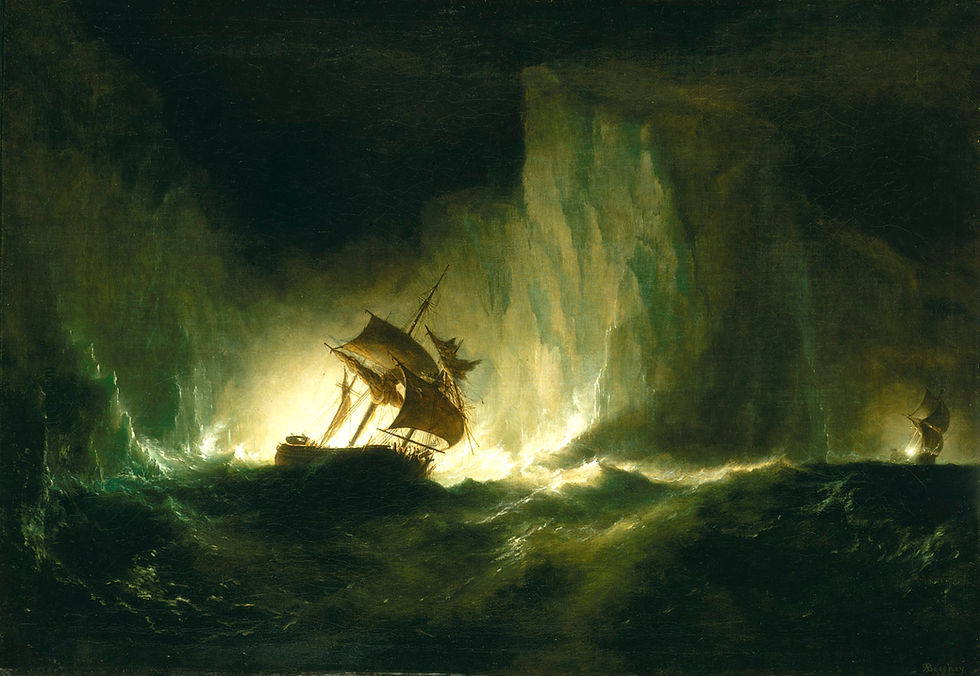
Coleridge's great ballad belongs on any serious Halloween reading list, though its supernatural machinery serves a purpose larger than mere fright. A mariner stops a wedding guest and compels him to hear the story of a voyage during which the killing of an albatross precipitates a nightmare of becalmed seas, spectral apparitions, death, and supernatural judgment.
The poem's extraordinary imaginative power lies in the way its eerie incidents gradually become a moral and spiritual drama. The mariner's punishment is not simply to suffer but to learn reverence for living things, while his compulsion to retell the story suggests a conscience that cannot find rest. Coleridge drew upon the supernatural ballad tradition but transformed it through elaborate symbolism, psychological intensity, and a haunting musicality.
The poem's memorable images—the lifeless ocean, the ghostly ship, the dreadful animation of the dead—have become part of the shared vocabulary of English literature. For Halloween, it offers a magnificent combination of maritime ghost story, supernatural curse, and meditation on guilt. It is also a useful corrective to the idea that Gothic poetry is merely decorative gloom: here, the darkness has moral weight.
5. “The Eve of St. Agnes” — John Keats (1820)
Keats's “The Eve of St. Agnes” is a Gothic romance in which beauty and menace are so intimately intertwined that it becomes difficult to distinguish enchantment from danger. On a bitter winter night, the young Madeline observes a ritual intended to reveal her future husband in a dream. Porphyro, her beloved but unwelcome suitor, enters the hostile castle and arranges to appear before her in the midst of this anticipated vision.
Keats's extraordinary descriptive powers turn the castle into a world of stained glass, tapestries, jewels, candlelight, and cold stone. Yet the poem's sensuous richness is shadowed by family hatred, vulnerability, and uncertainty about the lovers' escape. Keats drew upon medieval romance and Gothic fiction, but his poem is less interested in conventional supernatural explanations than in the strange power of desire, ritual, and dream.
Its place in the Gothic tradition rests partly on atmosphere: the snow outside, the sleeping household, and the lovers' passage through the darkness all make the castle feel suspended between waking life and nightmare. For Halloween readers who prefer their chills accompanied by exquisite craftsmanship, this is one of the season's most rewarding long poems.
6. “La Belle Dame sans Merci” — John Keats (1819)
Keats's “La Belle Dame sans Merci” is one of the most influential poems ever written about the dangerous enchantment of an elusive beloved. A knight-at-arms is discovered wandering a barren landscape, pale, exhausted, and alone. He recounts his encounter with a mysterious woman who seemed to belong to a fairy world, crowned him with flowers, and carried him to her enchanted grotto. There he dreamed of former victims who warned him that he, too, had been captured. The poem ends with the knight still lingering in a desolate landscape, unable to escape the memory of his encounter.
Its ballad form, spare dialogue, and recurring imagery of barrenness make the story feel ancient, even though its psychological ambiguity is distinctly Romantic. Is the lady a supernatural predator, a symbol of erotic obsession, or a projection of the knight's own imagination? Keats refuses to settle the matter.
The poem's legacy is enormous: the fatal enchantress became a central figure in later Gothic literature, Pre-Raphaelite art, and modern poetry. For Halloween, it offers something more seductive than a straightforward monster story: the terror of discovering that what has captivated you may also have destroyed you.
7. “Christabel” — Samuel Taylor Coleridge (1816)

Coleridge's unfinished narrative poem “Christabel” is among the great Gothic works of sexual and supernatural unease. The heroine encounters Geraldine, a mysterious woman found alone in the woods, and brings her home to her father's castle. Geraldine's presence gradually unsettles the household, while hints of physical vulnerability, hypnotic power, and concealed monstrosity accumulate without producing a fully explained revelation.
Coleridge's verse is crucial to the effect: its flexible, incantatory rhythms create an atmosphere of enchantment quite different from the strict regularity of traditional balladry. The poem also makes brilliant use of suggestion. Geraldine is never reduced to a neatly classified supernatural creature, and the reader is left to confront a disturbing combination of attraction, suspicion, and helplessness.
Although Coleridge never completed it, “Christabel” profoundly influenced the Gothic imagination, contributing to the tradition of the mysterious female stranger whose beauty conceals an ambiguous threat. Its unfinished state is almost an advantage for Halloween reading. Like a half-remembered nightmare, it leaves its most unsettling possibilities unresolved.
8. “The Raven” — Edgar Allan Poe (1845)
Poe's “The Raven” is perhaps the most famous Gothic poem in the English language, and its popularity can sometimes obscure how carefully it is constructed. A grieving speaker, alone on a bleak December night, is interrupted by a raven that enters his chamber and repeatedly answers his questions with the single word “Nevermore.” The bird's refrain becomes an instrument through which the speaker intensifies his own despair, moving from playful curiosity to desperate questions about reunion with his dead beloved.
Poe famously emphasized the calculated effects of poetic composition, and the poem's meter, internal rhyme, alliteration, and repeated sounds demonstrate that principle with almost theatrical precision. Its atmosphere of midnight, extinguished hope, and increasingly oppressive domestic confinement has become the archetype of the haunted mind. Yet the raven need not be a supernatural messenger in any literal sense: its power lies partly in the speaker's determination to make it one.
The poem's enormous cultural legacy includes countless parodies and adaptations, but its original effect remains remarkably strong when read aloud. For Halloween, it is a classic not merely because it features a sinister bird, but because it transforms grief itself into a haunting.
9. “The Haunted Palace” — Edgar Allan Poe (1839)
Poe's “The Haunted Palace” begins with the image of a magnificent dwelling whose windows shine with life and beauty. Gradually, however, its ordered splendor gives way to disorder, grotesque visitors, and a ruined interior. The palace is eventually revealed as an allegorical representation of a mind overcome by destructive forces.
Poe later incorporated the poem into “The Fall of the House of Usher,” where its imagery reflects the decline of Roderick Usher and his ancestral home. That context makes the poem especially interesting: the haunted building is not simply a location where something dreadful has happened, but a symbolic extension of the consciousness inhabiting it.
Its architectural imagery, musical movement, and transformation from harmony to madness anticipate one of the central ideas of Gothic fiction—that houses can embody family histories, psychological disorders, and spiritual decay. The poem also helped establish the haunted-house motif that would become a staple of later horror literature. Read independently, it is a compact and atmospheric Halloween poem; read alongside “The Fall of the House of Usher,” it becomes an elegant miniature of Poe's entire Gothic imagination.
10. “The Conqueror Worm” — Edgar Allan Poe (1843)

Poe's “The Conqueror Worm” is a Gothic pageant of existential horror. Humanity appears as a gathering of mournful spectators watching a theatrical performance whose actors are helpless, bewildered, and ultimately consumed by a monstrous figure. The poem concludes by identifying this worm as the conqueror of the human drama, transforming the spectacle into an allegory of mortality.
Its effect depends upon the collision between theatrical grandeur and grotesque inevitability: all our struggles, ambitions, and performances seem to lead toward the same final obscurity. Poe originally published the poem separately and later incorporated it into “Ligeia,” where it acquires an especially bleak significance. The result is one of his most uncompromising meditations on death.
Unlike “The Raven,” which dramatizes the private anguish of bereavement, “The Conqueror Worm” offers no consoling intimacy and no illusion that suffering can be escaped through memory. Its theatrical imagery makes it particularly effective read aloud, while its cosmic pessimism places it firmly within the darker currents of nineteenth-century Romanticism.
For Halloween, it supplies the evening's most philosophical chill: the suggestion that the entire world may be a stage upon which death has already written the ending.
11. “Goblin Market” — Christina Rossetti (1862)
Rossetti's “Goblin Market” is one of Victorian poetry's strangest and most enduring achievements: a fairy tale that seems at once innocent, erotic, devotional, and faintly horrifying. Two sisters, Laura and Lizzie, hear goblin merchants advertising their luscious fruits, and Laura succumbs to the temptation to taste them. The consequences are devastating. She becomes consumed by longing for the forbidden fruit, loses her vitality, and appears destined to waste away until Lizzie ventures to confront the goblins herself.
Rossetti's exuberant catalogues of fruit, grotesque descriptions of the goblin men, and almost hypnotic rhythms make the poem a feast of language as well as a tale of supernatural peril. Its allegory has prompted considerable debate: it has been read as a Christian account of temptation and redemption, a meditation on addiction, and a richly suggestive exploration of female solidarity and Victorian sexual anxieties. Rossetti resists reduction to any single interpretation, and the poem's peculiar power comes from the way its disturbing sensuality coexists with its moral seriousness.
For Halloween, “Goblin Market” offers a reminder that the most dangerous monsters are not always frightening to look at. Sometimes they arrive bearing gifts, promising pleasures that seem too delicious to refuse.
12. “The Kraken” — Alfred, Lord Tennyson (1830)
Tennyson's “The Kraken” is a miniature masterpiece of cosmic suspense. Beneath the ocean, in depths beyond the reach of ordinary human knowledge, an immense creature lies asleep amid ancient sea plants and strange marine life. The poem's slow, sonorous movement evokes a world largely untouched by human history, while its final lines promise that the Kraken will rise at the end of time, encounter humanity, and perish.
The creature belongs to a Scandinavian maritime legend popularized in European literature, but Tennyson transforms the legendary sea monster into something almost geological in its antiquity and scale. His subject is not merely a frightening animal but an existence so remote from humanity that its awakening would signal the collapse of familiar boundaries. Published while Tennyson was still a young poet, the work anticipates the Victorian fascination with deep time, evolutionary antiquity, and the sublime power of nature. It also points toward the cosmic monsters of later weird fiction, including the tradition that would culminate in H. P. Lovecraft.
For Halloween, it is a superb choice for readers who prefer their horrors vast, silent, and only dimly glimpsed. The Kraken is terrifying precisely because it has no interest in us—until the moment it rises.
13. “The Stolen Child” — W. B. Yeats (1886)

Yeats's “The Stolen Child” invites its young listener away from the human world and into the company of the Irish fairy folk. The supernatural speakers promise a landscape of pools, moonlit glades, and mysterious pleasures, repeatedly contrasting their enchanted country with the sadness and suffering of ordinary life. The refrain, with its invitation to come away, is among the most memorable in modern poetry: beautiful enough to be irresistible, yet ominous enough to suggest that the invitation may be permanent.
Yeats drew upon Irish folklore at a time when the recovery of national traditions was becoming central to the Irish literary revival. But he does more than reproduce traditional fairy lore. His fairies are neither simply benevolent nor straightforwardly wicked; they represent an alternative existence whose attractions are inseparable from the abandonment of human attachments. The poem's final movement, in which the world of ordinary life intrudes upon the enchanted vision, gives the invitation its melancholy force.
For Halloween, “The Stolen Child” captures the older, more unsettling meaning of fairy tales, in which the supernatural does not always attack us but may lure us away from everything we know. Its music is lovely; its implications are anything but reassuring.
14. “The Listeners” — Walter de la Mare (1912)
Few poems create an atmosphere of supernatural mystery with such economy as de la Mare's “The Listeners.” A Traveller arrives on horseback at a deserted house, knocks upon its door, and calls out a message to someone who does not answer. Inside, unseen listeners appear to be attending to his words, yet the Traveller receives no acknowledgment and eventually departs. Who are the listeners? Why has he come? What message must be delivered, and to whom? De la Mare declines to explain.
The poem's power lies in the contrast between the Traveller's concrete presence—the horse, the moonlight, the repeated knocks—and the invisible company whose existence he can neither confirm nor deny. Its measured rhythm and carefully repeated sounds make the empty house feel strangely alive. De la Mare was one of the great modern practitioners of supernatural suggestion, and “The Listeners” demonstrates his ability to create a ghost story out of silence itself.
Its legacy extends beyond conventional ghost poetry into the wider tradition of twentieth-century uncanny literature, where uncertainty becomes more disturbing than revelation. This is an especially fine Halloween poem for reading aloud in a quiet room. By the end, one may find oneself wondering whether the house is haunted, or whether the Traveller has simply been expected there all along.
15. “The Haunted Houses” — Henry Wadsworth Longfellow (1858)
Longfellow's “Haunted Houses” begins with a wonderfully disconcerting proposition: that every house is haunted, not necessarily by frightening spirits, but by the invisible presences of those who have inhabited it. The poem imagines the dead passing through familiar rooms, moving among the living without disturbing them, while memories and old associations linger in the very fabric of domestic life.
This is a gentler Gothicism than Poe's, and its tone is closer to philosophical reverie than outright horror. Yet the effect is surprisingly uncanny. A house becomes a place where different moments of time coexist, and the present occupants share their surroundings with lives that have vanished but are not entirely lost. Longfellow's accessible style and broad popularity helped make him one of nineteenth-century America's most widely read poets, although his work is sometimes underestimated today precisely because of its clarity.
“Haunted Houses” deserves better than a reputation for pleasant sentiment. Its central insight—that the dead persist through memory, habit, and the emotional history of places—anticipates much later writing about domestic spaces and the traces left by their former inhabitants. For Halloween, it provides a welcome alternative to the usual catalogue of horrors: a haunting that is poignant, intimate, and perhaps rather close to ordinary experience.
16. “The Highwayman” — Alfred Noyes (1906)

Noyes's “The Highwayman” is a late flowering of the Romantic ballad tradition, complete with moonlight, desperate love, violent death, and a supernatural conclusion. A highwayman rides to meet Bess, the landlord's daughter, but a jealous informer brings soldiers to the inn, where Bess is bound and used as bait. Her sacrifice warns her lover of the ambush, and he rides to his death in a futile attempt to reach her. The poem's final stanzas transform the tragedy into legend, with the lovers seemingly returning to their rendezvous on winter nights.
Noyes makes brilliant use of repetition, internal rhyme, and strongly accented lines, giving the poem a galloping musicality that makes it almost irresistible when read aloud. Its theatrical melodrama has sometimes invited parody, but that should not obscure its craftsmanship or its emotional effectiveness. The poem belongs to a period when the Victorian and Romantic fascination with historical ballads remained very much alive, even as modernist poetry was beginning to challenge inherited forms.
For Halloween, its combination of doomed romance, moonlit riding, and ghostly reunion makes it a natural choice. It is a reminder that a haunting can be not only an expression of terror but also a refusal to surrender love to death.
17. “The Witch of Coös” — Robert Frost (1922)
Frost's “The Witch of Coös” offers a particularly American kind of Gothic horror: the uncanny emerges from an isolated farmhouse, an ordinary family conversation, and the unsettling peculiarities of rural life. The poem's narrator recounts a visit to a woman suspected of witchcraft, whose appearance and behavior are disturbing enough without any conventional supernatural spectacle.
Frost's language is deceptively plain, and his dramatic storytelling allows the atmosphere to develop through dialogue, local knowledge, and the gradual accumulation of odd details. The poem is especially effective because it refuses to separate folklore from everyday life. Its witch belongs to a world where old superstitions remain woven into practical routines, and where a person's reputation may be as powerful as any actual spell. Frost's achievement is to bring the witch story into a modern poetic idiom without draining it of its strangeness. His speakers sound like recognizable people rather than characters in an antique Gothic romance, which makes their fears all the more persuasive.
“The Witch of Coös” is an excellent choice for readers who enjoy the folklore of back roads and remote communities, where the supernatural need not arrive with thunder and lightning. Sometimes it is already sitting at the kitchen table.
18. “Halloween” — Robert Burns (1785)
For a poem explicitly devoted to the season, it is hard to overlook Robert Burns's “Halloween.” Drawing upon the customs and superstitions of rural Scotland, Burns presents a lively account of the divinations, rituals, pranks, and romantic anxieties associated with the festival. Young people seek glimpses of their future spouses, interpret signs, and participate in customs whose apparent playfulness is inseparable from a genuine belief that the unseen world may disclose itself on this particular night.
Burns combines affection for local tradition with a keen eye for human folly, and his Scots dialect gives the poem
a vivid social texture that a more polished literary treatment might have lost. The result is less a conventional ghost story than a portrait of a community inhabiting a world in which the supernatural remains part of ordinary experience. Burns also preserves something historically valuable: Halloween appears here not simply as a modern occasion for costumes and sweets but as a complex folk festival shaped by harvest customs, courtship, and divination.
The poem is particularly rewarding when read alongside the German Romantic ballads, since both traditions reveal how deeply supernatural poetry draws upon communal storytelling. Burns provides the ideal "Historical Halloween" companion: spirited, affectionate, occasionally mischievous, and steeped in the old conviction that this is a night when ordinary rules may briefly loosen their hold.
19. “Theme in Yellow” — Carl Sandburg (1922)

Sandburg's “Theme in Yellow” takes the familiar Halloween pumpkin and turns it into a playful speaker, giving the season a distinctly modern and slightly absurdist flavor. The pumpkin addresses the reader with an air of comic self-importance, its yellow color and seasonal setting suggesting both the harvest and the strange transformations associated with Halloween. Sandburg's approach is a long way from Poe's elaborate musicality or the Romantic ballad's supernatural drama.
Instead, the poem depends upon colloquial directness, a touch of personification, and the surprising perspective of an object usually relegated to the margins of the holiday. Its lightness is precisely what makes it worth including. The Gothic tradition has never been exclusively solemn, and Halloween itself has always accommodated a mixture of genuine fear, theatrical play, and affectionate mockery. Sandburg, an important figure in American modernist poetry, was interested in ordinary objects and everyday voices, and this small poem demonstrates how the modern imagination could refresh a seasonal subject without burdening it with antique gloom.
It is especially suitable for a family reading, or as a palate cleanser between more disturbing works. After the haunted minds and spectral tragedies of Poe and Coleridge, it is pleasant to remember that Halloween has room for a pumpkin with a personality.
20. “Hallowe'en” — Madison Cawein (1910)
Cawein deserves a place on this list because he devoted so much of his poetic imagination to the haunted landscapes, folklore, and supernatural traditions of rural America. His “Hallowe'en” draws upon the familiar ingredients of the season—darkness, strange sounds, old beliefs, and the suggestion that the natural world may conceal more than it reveals—while retaining the lyrical sensibility of a poet steeped in Romantic and Victorian nature poetry.
Cawein's interest in local legend makes him a useful bridge between the European Gothic inheritance and the distinctly American supernatural landscape. His work often treats woods, fields, and twilight places as thresholds between the ordinary and the uncanny, where familiar surroundings acquire an almost enchanted character. Though he is less widely read today than many of the major poets represented here, his writing preserves a richly textured sense of regional folklore at a moment when modern life was rapidly changing the communities that sustained it.
That gives his seasonal poetry a particular charm: it looks back toward a world in which Halloween's rituals and fears remained close to the rhythms of the countryside. “Hallowe'en” brings us back to the holiday itself, not as a commercial spectacle but as an imaginative encounter with darkness, memory, and the old stories that continue to haunt the human mind.
21. “The Poor Ghost” — Christina Rossetti
Rossetti's ghost poetry is especially compelling when it considers the dead not as objects of terror but as souls with unfinished business. “The Poor Ghost” offers an unusual perspective on haunting, inviting sympathy for a spirit whose predicament is more pitiable than frightening. That reversal fits Rossetti's broader religious and poetic imagination, in which death is never merely a Gothic spectacle but a question of spiritual destiny, remembrance, and the relationship between the living and the dead.
Her characteristic economy of expression makes the supernatural feel intimate rather than theatrical. It would be a fine addition to a Halloween anthology precisely because it complicates our expectations: what if the ghost is not the source of the disturbance, but the one who most deserves our compassion?
22. “The Phantom Wooer” — Thomas Lovell Beddoes
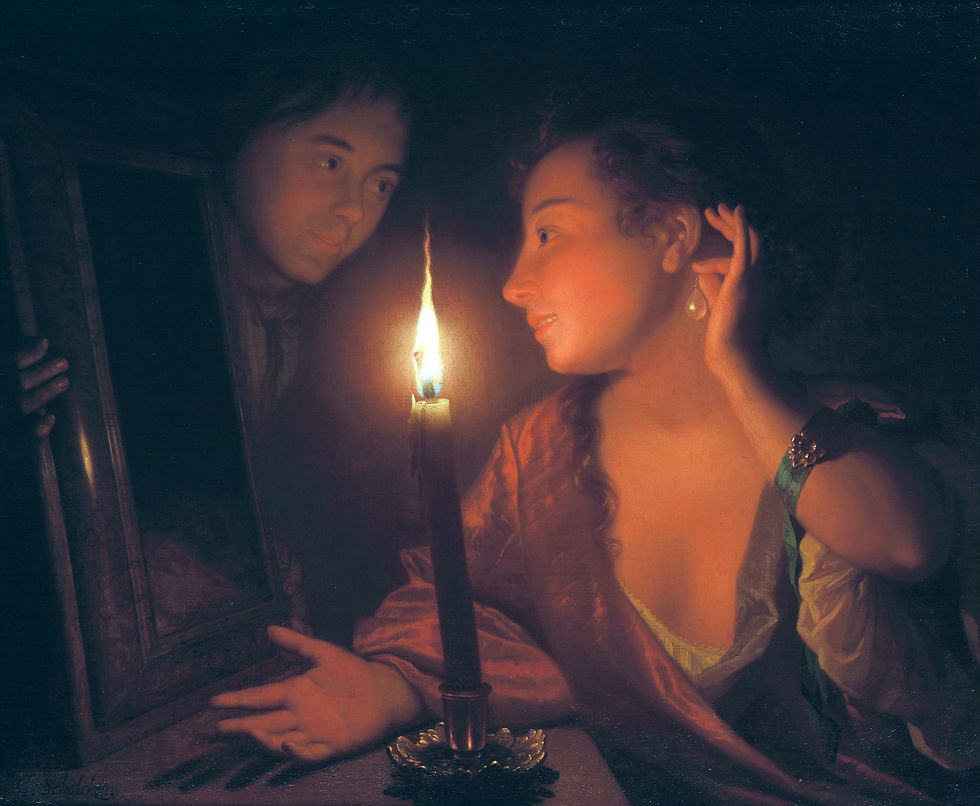
Beddoes is one of the great neglected figures of English Gothic verse: a poet fascinated by death, graveyards, spectral visitations, and the peculiar comedy of human mortality. In “The Phantom Wooer,” a ghostly lover courts a living woman with an invitation whose sweetness conceals its terrible destination. Beddoes's gift is his ability to make death both grotesque and seductive, drawing upon the theatrical traditions of the Elizabethan dramatists while anticipating the decadent fascination with beauty and corruption later associated with the fin de siècle.
His supernatural verse has an eerie, old-fashioned musicality, but its sensibility is surprisingly strange and modern. This is a choice for readers who have exhausted the familiar Poe repertoire and want something more
morbid, sardonic, and unsettling.
23. “The Laboratory” — Robert Browning (1844)
Browning's speaker is a woman who visits an apothecary to obtain a poison with which to murder her romantic rival. The poem's chilling achievement lies in the contrast between its lively, almost conversational voice and the speaker's increasingly evident cruelty. She treats the preparation of the poison as a fashionable diversion, delighting in the bottles, fumes, and promised effects while imagining the death of her enemy.
Browning's dramatic monologue allows the reader to inhabit a disturbed consciousness without receiving any reassuring authorial commentary. The poem belongs to the Victorian fascination with crime, forbidden knowledge, and the darker possibilities of respectable society. It is not supernatural in the literal sense, but it belongs to the Gothic tradition of sorcery and sinister female agency—and it makes an excellent Halloween selection for those who find human wickedness more frightening than ghosts.
24. “The Witch of Atlas” — Percy Bysshe Shelley (1820)
Shelley's elaborate narrative poem introduces an extraordinary supernatural enchantress who inhabits a remote mountain and travels through a fantastic world of transformations, inventions, and magical adventures. Unlike the sinister witches of conventional folklore, Shelley's heroine is playful, independent, and difficult to classify.
The poem combines classical mythology, Romantic idealism, and a delight in the marvelous that makes it rather different from the season's more fearsome offerings. Its inclusion would broaden the anthology beyond ghosts and monsters, reminding readers that the Gothic and the fantastic often overlap with imaginative freedom and philosophical speculation. Shelley is interested less in frightening his audience than in loosening the boundaries of the possible.
“The Witch of Atlas” offers a welcome change of atmosphere: a dreamlike, otherworldly excursion in which enchantment is not necessarily evil and the supernatural world is stranger, more beautiful, and more ambiguous than we might expect.
25. “Tam Lin” — Traditional Scottish Ballad

Few traditional ballads are better suited to Halloween than “Tam Lin,” in which Janet encounters a mysterious young man in the woods and discovers that he belongs to the fairy world. Tam Lin reveals that the Fairy Queen intends to use him as a sacrifice, and Janet must rescue him by holding fast while he undergoes a series of terrifying transformations.
The ballad's roots reach into the rich oral traditions of the Scottish Borders, where the fairy realm was often imagined as a genuine and perilous alternative to ordinary existence. Its heroine is particularly striking: Janet's courage, resolve, and physical endurance make her an active participant in the supernatural struggle rather than a passive victim.
The changing forms of Tam Lin lend the story a marvelous sequence of grotesque and uncanny images, while its emotional center is the power of human attachment to overcome enchantment. It is an essential choice for a collection that wants to preserve the older, folkloric spirit of Halloween.
26. “Little Orphant Annie” — James Whitcomb Riley (1885)
Riley's celebrated poem turns a fireside storytelling session into a catalogue of supernatural warnings. Annie recounts the terrible fates of disobedient children, invoking goblins and other frightening creatures in the dialect and rhythms of rural Indiana. Its refrain, warning that the goblins will come and get you, has become one of the most recognizable expressions of American childhood folklore.
Riley's genius is to preserve the pleasures of oral storytelling: the direct address, the conversational voice, the accumulating details, and the sense that the speaker has heard these tales from people who genuinely believe them. The poem also offers a valuable regional counterpart to the European ballads of Goethe and Bürger. Its supernatural creatures belong to the domestic world of chores, family discipline, and country life. It is particularly effective read aloud, especially to younger listeners, though its grotesque punishments retain a genuine edge of menace for adults as well.
27. “The Shadow on the Stone” — Thomas Hardy (1916)
Hardy's poem is a hauntingly restrained meditation on bereavement. The speaker believes he sees the shadow of his dead wife on a garden stone, but when he approaches, the apparition disappears. The scene is almost painfully ordinary: a familiar garden, a stone, the changing light, and the possibility that grief has made the absent beloved momentarily present.
Hardy's late poetry often explores the persistence of memory and the bewildering emotional afterlife of relationships, and this poem is among his most effective expressions of that theme. It leaves open whether the shadow is supernatural or psychological, without diminishing the experience's emotional reality. That ambiguity places Hardy firmly within the modern development of the ghost poem, where the question is not always whether a spirit exists but what its appearance means to the living. This is an ideal quieter selection: an autumnal haunting whose sadness lingers longer than any conventional shock.
28. “Ulalume” — Edgar Allan Poe (1847)

Poe's “Ulalume” takes the familiar Gothic theme of a dead beloved and turns it into a dreamlike journey through a landscape of psychological disorientation. The speaker wanders with a mysterious companion through a desolate October night, unaware that his path is leading him back to the tomb of Ulalume, whose death he has apparently forgotten. The poem's elaborate sound patterns, strange names, and recurring images of darkness create an atmosphere closer to a nightmare than to a conventional narrative.
Its most disturbing idea is that the mind can repeat its grief even when conscious memory fails: the speaker is drawn back to a place of suffering before he understands why. Poe's poem is sometimes criticized for its artificiality, but that very artificiality is part of its effect, creating a world in which ordinary speech and ordinary perception have broken down. Its October setting and uncanny emotional logic make it one of the season's most atmospheric poems.
29. “Ghost House” — Robert Frost (1914)
Frost's “Ghost House” is a small, beautiful poem about a deserted place where the speaker and his companion seem to encounter the traces of an earlier life. The house is no longer inhabited in the ordinary sense, yet the landscape remains animated by presences that suggest a continuity between past and present. Frost's language is plain and unassuming, but that simplicity gives the poem its peculiar atmosphere: the uncanny is not imposed upon nature but seems to emerge naturally from it.
The poem also anticipates the modern ghost story's interest in absence, memory, and the emotional history of places. Rather than constructing a dramatic haunting, Frost allows the reader to feel that the world has become quietly inhabited by something no longer visible. It belongs alongside Hardy and de la Mare as an example of how twentieth-century poets transformed Gothic conventions into subtler, more reflective forms. “Ghost House” offers the pleasure of a haunting without the noise of a slammed door.
30. “The Mistletoe Bough” — Thomas Haynes Bayly (1830s)
Bayly's famous ballad recounts the tragic legend of a bride who, while playing hide-and-seek during her wedding festivities, conceals herself in an old chest and becomes trapped inside. Years pass before her skeleton is discovered, still wearing the remains of her bridal dress. The story became a popular Victorian legend, inspiring illustrations, theatrical treatments, and retellings that helped establish it as one of the era's best-known domestic ghost narratives.
Its horror is rooted in a particularly Gothic contrast: a house filled with music, celebration, and youthful happiness becomes the setting for a death that goes unnoticed for years. The poem's sentimental ballad style may seem old-fashioned, but its central image is genuinely chilling, and its combination of romance, mystery, and macabre revelation is ideally suited to Halloween. It also offers a useful reminder that the haunted-house tradition often begins not with an invading spirit but with a terrible secret buried within the home itself.
“The Ghost” — Charles Baudelaire

Baudelaire's “The Ghost” brings a touch of French Symbolist sensibility to a Halloween anthology, exploring the unsettling intimacy between beauty, desire, and death. Baudelaire was one of the defining poets of modernity, fascinated by the corruption lurking beneath civilized appearances and by the strange allure of things that conventional morality deemed disturbing. His poetry often makes the uncanny less a matter of supernatural spectacle than of psychological disturbance: the sense that something dark and irresistible has entered ordinary consciousness.
That sensibility makes him a natural companion to Poe, whose work Baudelaire famously translated and championed in France. Including Baudelaire also broadens the anthology's geographical and literary scope, reminding readers that Gothic poetry was never exclusively an English-language tradition.
His presence offers a different flavor of unease from the balladry of Bürger or the mournful supernaturalism of Hardy: more intimate, more sensual, and more psychologically ambiguous. Baudelaire is a fitting final addition because he captures one of the Gothic imagination's most enduring fascinations—the possibility that the things which haunt us are not always alien intrusions, but desires and fears already dwelling within ourselves.
A Final Thought
The finest Gothic poetry does not simply populate the darkness with monsters. It asks what the darkness makes visible: grief that cannot be put to rest, desire that leads us astray, guilt that follows us through life, or the mysterious persistence of those who have gone before us. Sometimes the supernatural appears in unmistakable form; sometimes it remains no more than a voice at a closed door, a shape in the trees, or a silence that seems to be listening.
That ambiguity is part of the tradition's enduring appeal. From Bürger's spectral rider to de la Mare's unseen company, from Keats's dangerous enchantress to Frost's unsettling country witch, these poets understand that the imagination is an indispensable accomplice to fear. The reader must supply something of the haunting.
So light a candle, draw the curtains, and give one or two of these poems the attention they deserve. Halloween is an excellent occasion to revisit the dead, but poetry offers a more lasting invitation: to discover how much of the uncanny still lives among us, waiting patiently for someone to notice.
...oh, and don't forget to check out our own seasonal anthology of Classic Spooky Poems for Halloween Night, in which you can find each of these poems and more!