


Washington Irving's The Legend of the Arabian Astrologer, Explained: A Detailed Summary and Literary Analysis

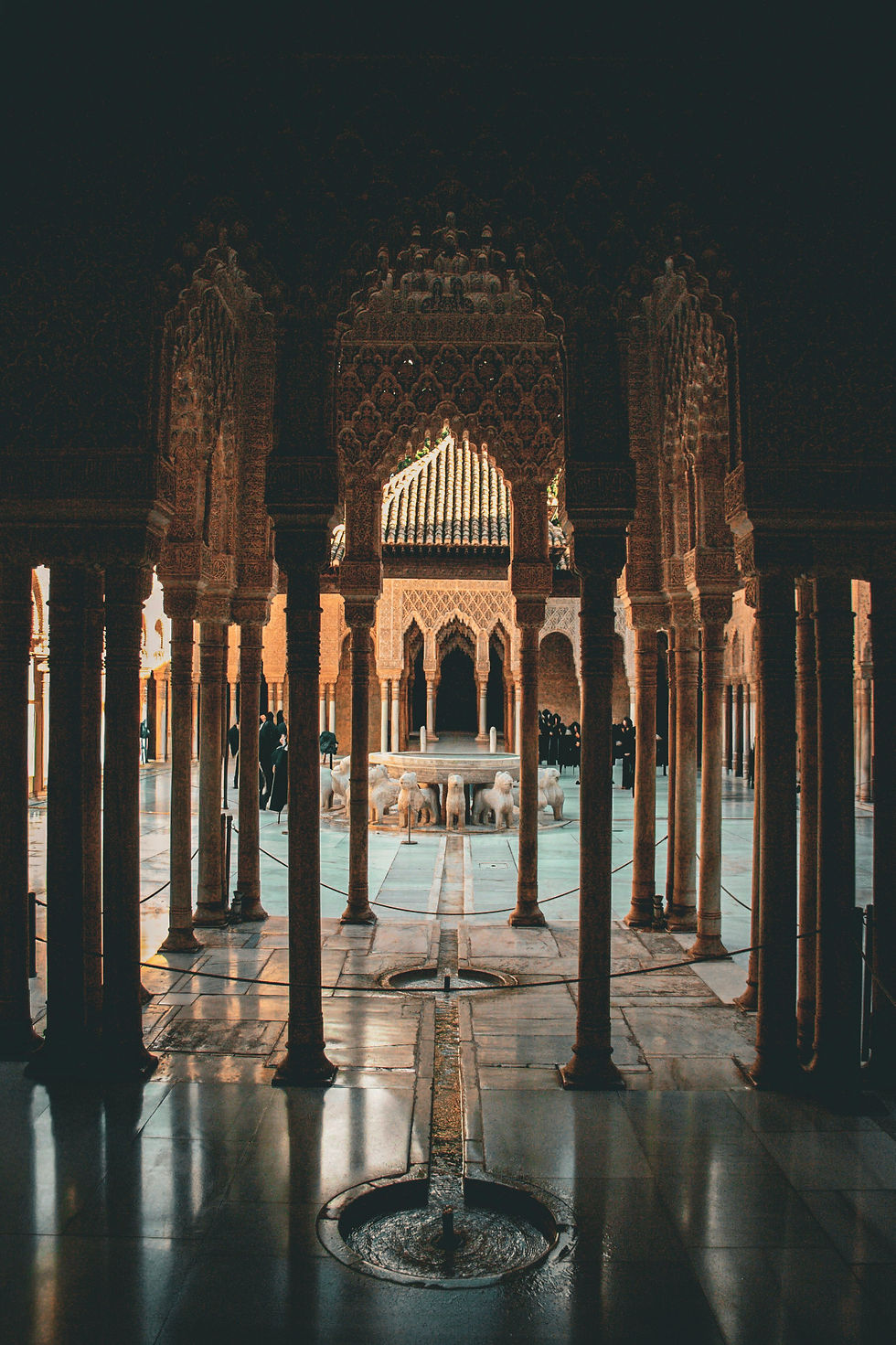
The entirety of The Alhambra is given over to dreamy vistas, wistful romances, solemn reflections, and earnest moralizing. Written while Irving was living in Granada under the shadow of the Alhambra Palace—a breathtaking fortress-palace whose surviving structures were chiefly constructed during the thirteenth and fourteenth centuries by the Muslim Nasrid dynasty atop the ruins of earlier fortifications—the work is steeped in the atmosphere of memory, ruin, and recovered legend.
Described as “a pearl set in emeralds,” the Alhambra had long stood as a symbol of a romantic and irrecoverable past: a world associated with chivalry, refinement, and the mingling of cultures. Though modern historians rightly complicate nostalgic visions of medieval convivencia, Muslim-ruled Granada nevertheless became, in the nineteenth-century imagination, an emblem of comparative religious and cultural exchange among Christians, Muslims, and Jews—a vision of civility that deeply appealed to Romantic writers.
II.
For all of Irving’s reputed conservatism, he was also a profoundly cosmopolitan and curious observer of cultures, marked by unusual tolerance and sympathy. In the Alhambra he found not merely a picturesque ruin, but an icon of the civility and imaginative richness he felt wanting amid the rancorous political atmosphere of Jacksonian America.
Living for several months in rooms within the palace itself, Irving immersed himself in local legends, Moorish histories, and folk traditions told to him by guides, soldiers, and townspeople. The Alhambra—ostensibly narrated by Geoffrey Crayon—soon became known as “The Spanish Sketch Book,” and with good reason.
While Bracebridge Hall is remembered for its humor and genial sense of community, and Tales of a Traveller for its irony, gloom, and occasional incursions into the supernatural, The Alhambra revived the eclectic spirit of Irving’s first international triumph, The Sketch Book of Geoffrey Crayon, Gent.. Both collections blend essays, travelogue, folklore, history, fiction, fantasy, satire, romance, and biography with an effortless grace that resists rigid genre.
III.
Yet The Alhambra is also distinctly a product of the Romantic fascination with the “Orient”—that broad nineteenth-century imaginative category encompassing the Middle East, North Africa, and Islamic Spain. Irving drew heavily from Spanish legend, Arabic folklore, and, above all, the storytelling traditions associated with The Thousand and One Nights (or Arabian Nights), whose influence pervades the collection’s atmosphere of magic, fate, and moral parable.
If the supernatural tales of The Sketch Book owed much to European Gothicism—with its ghosts, goblins, and haunted landscapes—The Alhambra embraces a more luxuriant and fantastical mode populated by talismans, enchantments, hidden chambers, and wise or dangerous magicians. Such stories reflected not merely Irving’s literary tastes, but a growing European enthusiasm for translated Eastern literature following the immense popularity of Arabian Nights in the eighteenth and nineteenth centuries.
One of the most celebrated entries is the following tale: a parable worthy of Arabian Nights, complete with a crafty magician, a pompous monarch, a mysterious captive princess, and a spellbinding vision of enchanted power.
SUMMARY
In the days when Muslim Granada flourished beneath the rule of Moorish kings, there lived an aging monarch named Aben Habuz, a conqueror grown weary of conquest. Having spent his youth “in constant foray and depredation,” he had come to “languish for repose,” desiring only peace and quiet in his old age. Yet repose proved elusive. Granada was hemmed in by rugged mountains that concealed enemies, and rival rulers frequently raided his lands. Despite watchtowers, sentries, smoke signals, and constant vigilance, foes continually slipped through mountain passes to ravage his kingdom before vanishing into the hills. The old king grew increasingly anxious and miserable.
Relief appeared in the form of a mysterious traveler: an aged Arabian physician and astrologer named Ibrahim Ebn Abu Ayub. Gray-bearded and impossibly old, Ibrahim was rumored to have lived since the time of the Prophet Muhammad and to have journeyed on foot from Egypt, armed only with a staff covered in hieroglyphics. He was said to have mastered ancient magic and discovered the secret to extending life, though only after old age had already overtaken him. The king welcomed the sage warmly, but Ibrahim chose not to live in the palace, instead carving out a cave on the hillside above Granada, later the site of the Alhambra, where he created a secret hall inscribed with “Egyptian hieroglyphics,” “cabalistic symbols,” and astrological figures.
One day, hearing Aben Habuz complain of endless threats, Ibrahim recounted a marvel he had once seen in Egypt: a brass ram and cock that warned a city of approaching enemies. The king exclaimed with delight, crying, “Allah Akbar! how securely I might sleep in my palace with such sentinels on the top!” Ibrahim then revealed that, while in Egypt, he had stolen a magical volume of wisdom from the heart of a pyramid—a sacred book allegedly passed from Adam to Solomon himself. Through it, he explained, he had learned to command genii and master powerful talismans.
At the king’s request, Ibrahim built a magical watchtower atop Granada. Inside was a hall containing miniature armies arranged on tables corresponding to every direction around the kingdom. Above the tower stood a bronze Moorish horseman mounted on a pivot. Whenever danger approached, the figure would turn and point its lance toward the threatened pass.
Soon the talisman proved its worth. When the bronze rider turned toward the Pass of Lope, Ibrahim led the king into the secret chamber. To Aben Habuz’s amazement, the tiny wooden soldiers moved as though alive: horses “pranced and curveted,” warriors brandished weapons, and faint battle sounds hummed in the chamber. Ibrahim explained that by striking the figures with a magical lance, the king could influence events in reality. Aben Habuz, delighted at the prospect, cried gleefully, “I think we will have a little blood!” He struck the figures, throwing enemy troops into confusion. Scouts later confirmed that a Christian army had mysteriously fallen into deadly infighting and retreated.
Overjoyed, Aben Habuz granted Ibrahim funds to furnish his mountain retreat. What began as a cave became an extravagant underground palace with luxurious divans, baths perfumed with aromatic oils, endless silver lamps burning perpetual light, and even beautiful dancing women. The king grumbled at the expense but admired the philosopher’s moderation.
Meanwhile, Aben Habuz became increasingly addicted to magical warfare. He delighted in conducting campaigns from his chamber, destroying armies “like so many swarms of flies.” Eventually, however, neighboring kingdoms learned caution, and invasions ceased. Deprived of his amusement, the king became restless.
One day the bronze horseman turned suddenly toward the mountains of Guadix, yet no army appeared on the magical board. Scouts searched the hills and instead discovered a sleeping Christian maiden of surpassing beauty. She was brought before the king adorned with jewels and carrying a silver lyre. Aben Habuz was instantly enchanted: “The flashes of her dark refulgent eye were like sparks of fire on the withered, yet combustible, heart of Aben Habuz.”
The princess claimed to be the daughter of a defeated Gothic ruler. Ibrahim warned the king that she might be a dangerous sorceress, declaring, “Methinks I read witchcraft in her eye.” Yet the king ignored him, boasting that in matters of women he would “yield to no man; no, not to the wise Solomon himself.” Ibrahim then requested the princess as his reward, wishing for “a little minstrelsy to refresh my mind,” but Aben Habuz angrily refused, comparing his attachment to hers with King David’s comfort in the companionship of Abishag.
Consumed with infatuation, Aben Habuz lavished treasures upon the princess. Granada’s markets were emptied of silks, jewels, perfumes, spectacles, and entertainments to amuse her. Yet she remained emotionally distant. Whenever the king attempted to plead his passion, she would strike her silver lyre. Instantly, he would fall asleep, soothed into dreams that left him refreshed but no closer to winning her affection.
Eventually unrest broke out in Granada itself. Citizens, outraged at the king’s extravagance and obsession, rebelled against him. Though he suppressed the uprising, Aben Habuz finally turned to Ibrahim for help. The astrologer advised him to abandon the princess, warning, “Thou art in danger of losing both” kingdom and beloved. But the king insisted he desired only peace and love.
Ibrahim then proposed building a hidden paradise modeled after the legendary Garden of Irem, a magical city he claimed to have visited in Arabia. The astrologer promised to create an invisible palace of gardens, baths, and fountains atop the mountain, protected by powerful enchantments. In return, he requested only “the first beast of burden, with its load, which shall enter the magic portal.”
The eager king agreed. Soon a mysterious gateway adorned with a giant carved hand and key rose atop the hill. Ibrahim declared that no mortal power could breach the sanctuary unless “yonder hand shall reach down and seize that key.”
At dawn, Aben Habuz rode up the mountain beside the princess. Yet no palace was visible, for the enchantment concealed it. As they paused beneath the gateway, the princess’s palfrey stepped through the portal. Ibrahim immediately announced, “Behold my promised reward; the first animal with its burden which should enter the magic gateway.”
Furious, Aben Habuz accused him of deceit, offering treasure instead. But Ibrahim refused, insisting the princess belonged to him by oath. The king angrily declared himself master, whereupon the astrologer mocked him as “the monarch of a molehill.”
Suddenly, Ibrahim seized the princess’s bridle, struck the earth with his staff, and vanished with her beneath the gateway into the mountain itself.
Desperate, Aben Habuz ordered excavations, but the hill resisted every effort. The astrologer’s cave had vanished, and the bronze horseman remained forever fixed, pointing accusingly toward the mountain. Occasionally, villagers claimed to hear music from below, and one peasant reported glimpsing Ibrahim underground, slumbering on a magnificent divan while the princess played her enchanted lyre.
Aben Habuz never recovered. Stripped of magical protection, he suffered renewed invasions until his death. Over time, the enchanted gateway supposedly became the Gate of Justice of the Alhambra, where, legend held, the astrologer still slumbered beneath the mountain, lulled eternally by the princess’s silver music.
ANALYSIS

Like The Arabian Nights—whose tales of wonder almost invariably carry a moral lesson—the supernatural stories of The Alhambra are nearly always cautionary, laden with ethical warnings and practical wisdom. Written in the style of ancient fables, they skimp neither on action nor moral instruction. “The Legend of the Arabian Astrologer,” in particular, offers a comparatively straightforward meditation on the dangers of greed, the necessity of self-control, and the delusions of sensual desire.
Like “Ali Baba and the Forty Thieves,” “Aladdin and His Wonderful Lamp,” or even “King Midas and the Golden Touch,” it employs fantasy as a vehicle for moral reflection, weighing the merits of moderation, humility, and contentment against the corrosive effects of appetite unchecked. Many of The Alhambra tales concern themselves with the virtues of integrity, the pitfalls of acquisitiveness, the eventual punishment of greed and corruption, and the delayed but inevitable triumph of honesty and virtue.
While Irving’s earlier fiction often carried a moral implication, he was famously reluctant to moralize overtly—recall the baffled skepticism of the “quizzical old gentleman” in the epilogue to The Legend of Sleepy Hollow, or the genial uncertainty of Diedrich Knickerbocker, who delights in recounting stories he scarcely believes himself.
The Alhambra, however, is populated by sage parables in which moral instruction arrives with every helping of wonder. Irving writes less as an amused antiquarian than as a storyteller consciously reviving the atmosphere of medieval exempla and Eastern fables, where enchantment exists not merely to entertain but to illuminate human weakness.
II.
Yet the story’s moral vision is more complicated than a simple condemnation of greed or lust. The aging Aben Habuz begins as a ruler who sincerely longs for peace and repose, but prosperity itself corrupts him. Once the astrologer’s talisman grants him effortless military supremacy, he gradually abandons moderation and becomes addicted to domination, provoking conflicts simply for the pleasure of winning them. Irving thus anticipates a recurring modern insight: technologies of power—especially those that remove risk or consequence—rarely make men more virtuous. Instead, they often magnify dormant appetites. The king’s moral decline begins not with romance but with comfort, boredom, and unchecked security. By the time he encounters the Gothic princess, he has already become vulnerable to the deeper self-deceptions of vanity and desire.
The astrologer himself likewise complicates the tale’s ethical framework. Although he initially appears to function as a wise counselor or fairy-tale benefactor, he gradually reveals himself to be motivated by resentment, manipulation, and possessiveness. In this respect, the story resists the tidy binaries common to folk narrative: neither king nor magician emerges morally superior. Aben Habuz abuses magical power for conquest and pleasure, while Ibrahim exploits wisdom itself for personal gain. The Gothic princess, meanwhile, remains curiously enigmatic—perhaps enchantress, perhaps political captive, perhaps merely an opportunistic survivor—her silver lyre functioning almost as a symbol of irresistible illusion.
In the end, all three characters become prisoners of appetite: the king of longing, the astrologer of envy, and the princess of an enchanted captivity that leaves the tale suspended between romance and punishment. The result is a fable less about wickedness than about the tragic absurdity of human desire, where those most determined to possess happiness invariably lose it.