


Washington Irving's The Legend of the Engulfed Convent, Explained: A Detailed Summary and Literary Analysis

Like “Guests from Gibbet Island,” the following tale is both grimmer than Irving’s usual fare and was first published in the Knickerbocker Magazine. Profoundly wistful—melancholy and dreamlike—it seems to offer a female-led counterpart to “The Legend of Don Munio de Sancho Hinojosa,” wherein a spectral company is glimpsed performing solemn rites beyond the veil of ordinary life. Here, instead of armored penitents, we encounter a sisterhood of nuns, preserved in sanctity and memory, whose final act is not one of vengeance or unrest, but of sacred withdrawal.
As in “Don Munio Sancho de Hinojosa,” the tale meditates on virtue, immortality, honor, and the mysterious endurance of the human will when aligned with divine purpose. Yet “The Legend of the Engulfed Convent” is also deeply rooted in the historical imagination of medieval Spain.
Its opening invokes the stunning Muslim conquest of Christian Spain following the defeat of King Roderick at the Battle of Guadalete in 711, an event that marked the beginning of centuries of Muslim governance over much of the Iberian Peninsula. For Irving and his contemporaries, this period—often filtered through romantic and nationalistic lenses—was imagined as an age of loss, displacement, and spiritual trial for Christian Spain. The story’s emphasis on violated sanctuaries and imperiled chastity reflects long-standing literary traditions that dramatize the Moorish conquest as both a political and moral crisis.
II.
At the same time, the legend participates in a broader body of European folklore concerning “sunken” or “hidden” sacred spaces—churches, cities, or monasteries that vanish miraculously to escape desecration, only to echo faintly through time with bells, chants, or ghostly processions. While no specific historical convent near Toledo can be definitively identified as the source of Irving’s tale, the motif itself is well attested across Christian storytelling traditions, where divine intervention preserves holiness by removing it from the fallen world rather than allowing its corruption.
Irving, characteristically, blurs the line between recorded history and imaginative reconstruction. Drawing on Spanish chronicles, Catholic devotional literature, and oral legend, he crafts a narrative that feels at once authoritative and dreamlike. The result is less a retelling of a fixed legend than a literary synthesis—an elegy for a vanished world, in which faith endures not through triumph, but through disappearance, memory, and the quiet persistence of the unseen.
SUMMARY
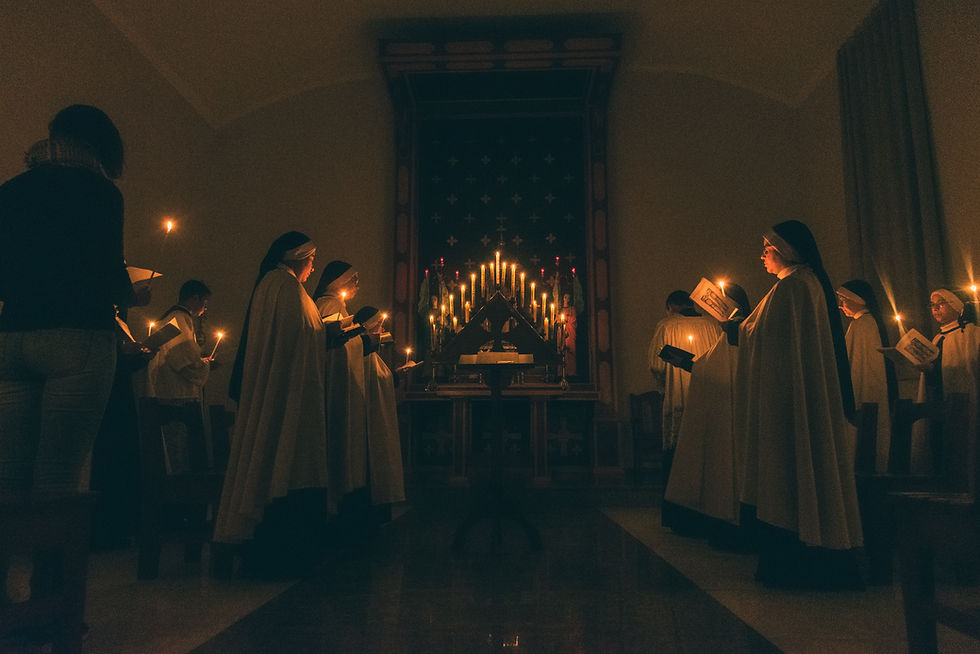
Set during the conquest of Visigothic Spain after the defeat of King Roderick, this legend recounts a miraculous act of divine preservation and its haunting aftermath. As Moorish forces overrun the country churches and convents are destroyed with particular zeal. One such threatened sanctuary is a Benedictine convent near Toledo, inhabited by noble-born nuns renowned for “the purest blood, the most immaculate virtue, and most resplendent beauty.”
When news arrives that Toledo has fallen and a band of Saracens approaches, terror grips the convent. The nuns cry out in desperation as the attackers batter the gates. Turning to their abbess—herself a woman long preserved by providential miracles—they beg for deliverance.
Though uncertain whether such intervention can extend to all, she leads them into the chapel and prays before the Virgin Mary: that the earth might swallow them rather than allow their vows to be violated.
Her prayer is answered instantly. As the invaders break in, “the earth yawned,” and the entire convent sinks beneath the ground, the chapel tower disappearing last as its bell rings triumphantly. The nuns are thus preserved from dishonor through miraculous removal, transforming destruction into spiritual victory.
Forty years later, Spain lies under Moorish rule. A Christian cavalier from Cordova, traveling secretly to join a northern resistance, passes through a forested hill and hears the unexpected sound of a vesper bell. Following it, he enters a clearing where unseen voices chant evening prayers, accompanied by an organ. The music stirs deep longing for the lost Christian past, yet no source is visible; the sounds seem to come “from within the bosom of the earth.” When silence falls, he finds only a moss-covered stone cross standing alone.
That night, he dreams—or experiences—a vision. The vanished convent reappears, and he witnesses a funeral procession of nuns chanting over the body of an aged sister. At the close, a voice intones, “Requiescat in pace!” and the entire scene dissolves, leaving him once more beneath the cross.
The next day, a hermit explains the mystery: the convent, swallowed decades before, continues to echo beneath the earth. Its bells, organ, and voices have long been heard in the area, which the Moors avoid as haunted ground. The cavalier’s vision, however, marks the end. It is believed he witnessed the final burial rites of the last surviving nun, after which all sounds ceased.
The site remains a place of pilgrimage, marked only by the solitary cross. Some believe the convent still lies intact within the hill, miraculously preserved with its relics and tombs. The tale closes by affirming this as a true act of divine intervention, preserving sacred purity even in the face of conquest, while leaving behind a lingering, mournful echo of a vanished Christian world.
ANALYSIS

Irving is frequently accused of being saccharine and light-headed, but the previous two stories ["Engulfed Convent" and "The Legend of Don Munio Sancho de Hinojosa" -- which are published back to back in our Irving anthology, along with this analysis] arguably put such accusations to rest. Both tales could have easily ended with the rescue of divine intervention – a happy ending with a sweet resolution – but the closest we get to that is in the latter story, where an earthquake kills a company of nuns before they can be gang raped. This is not exactly the stuff of lite fairy tales. Indeed, Irving could have chosen to have the earthquake destroy the oncoming warriors, but instead he sacrifices his huddled cloister in an act of passionate violence.
There isn’t even enough evidence to verify that this was an act of God: it could have been mere coincidence. And if this isn’t enough, as in so many of his stories (“The German Student,” “The Bold Dragoon,” “Rip Van Winkle,” “Sleepy Hollow”), Irving uses the last few lines to throw doubt on the whole story (cf. “faith sir, I don’t believe one half of it myself!”) by attributing the tale to his favorite shadow man: a fat friar. But what fascinates Irving isn’t obvious wonders or demonstrable marvels – it is the fleeting suggestion that they may have occurred.
Throughout his supernatural fiction, Irving – hardly the simplistic sentimentalist he has so often been lampooned to be – has preferred open-ended hauntings with only the slightest fiber of possibility supporting the chance of supernatural intervention. Rip Van Winkle could have merely run off. Ichabod Crane could have been chased away by Brom Bones. Dolph Heyliger could have merely had visited by a set of coincidental cheese dreams. Wolfert Webber could have been pursued by a living man who survived drowning. The German student could have been a psychotic necrophile. The Bold Dragoon could have been inventing a story to conceal a fit of rowdy sex. It could all be a pack of banal lies…
But Irving wants us to believe – Irving himself wants to believe – in the possibility of wonders and ideals and miracles: of immortality, justice, honor, love, and virtue. Throughout his life he struggled to hold on to his innate optimism and good cheer. It was a struggle indeed, but there was always something in him that longed to believe that the nuns were supernaturally preserved within the earth’s protective womb – that the Headless Horseman rode forth to drive off the scheming Ichabod, that Dolph Heyliger was more than just a lucky kid, that Rip Van Winkle actually tasted the magic brew of undiluted leisure – and two hundred years later, so do we…