


Washington Irving's The Legend of the Two Discreet Statues, Explained: A Detailed Summary and a Literary Analysis

Haunted by Spanish superstition and Moorish folklore, this tale serves as a sequel to Tales of the Alhambra’s “The Arabian Astrologer,” reuniting readers with the enchanted Gothic princess while further developing one of the central morals of the Alhambra legends: that humility and virtue are ultimately rewarded, while greed and corruption invite humiliation and ruin. Opening on St. John’s Eve (traditionally celebrated on the night of June 23) — a liminal feast like St. Mark’s Eve or All Hallows’ Eve, when the invisible world is believed to brush against the mortal one — the story follows a poor family’s fateful encounter with a supernatural secret, the greedy machinations of a worldly friar, and a galloping climax that strongly anticipates the comic terror of “The Legend of Sleepy Hollow.”
II.
Modern readers may especially benefit from understanding the unusual cultural crossroads that shaped these legends. Irving’s Alhambra tales are steeped in the atmosphere of Granada after the fall of Moorish Spain, when Christian Spaniards inherited the palaces, gardens, folklore, and architectural wonders of the defeated Muslim kingdoms. Throughout the story, Irving draws on real places within the Alhambra — including the Court of Lions, the Generalife gardens, and the Gate of Justice — all of which were already surrounded by ghost stories, treasure legends, and tales of enchanted Moorish kings lingering beneath the hills.
The narrative also reflects popular Spanish folk beliefs about St. John’s Eve bonfires, protective talismans against the evil eye, hidden Arab treasure caches, and the uneasy mixture of Catholic devotion with older magical traditions inherited from both medieval Christianity and Islamic Andalusia. Even the comic figure of the friar belongs to a long tradition of Spanish satire in which gluttonous or worldly clergymen are mocked alongside gullible peasants, wandering soldiers, and boastful nobles.
Understanding this blend of history, superstition, religion, and folklore helps explain the dreamlike tone of the tale, where ruined palaces seem alive with memory and the boundary between legend and reality is always uncertain.
SUMMARY
In Tales of the Alhambra’s “The Legend of the Two Discreet Statues,” Washington Irving tells the story of Lope Sanchez, a cheerful laborer who lives with his wife and daughter in the decaying apartments of the Alhambra. Lope is a lively, carefree man who spends his days gardening and entertaining the old soldiers of the fortress by singing ballads about Spanish heroes such as the Cid and Bernardo del Carpio. Though poor, he is contented, especially because of his beloved daughter Sanchica, “a little black-eyed girl about twelve years of age,” who shares her father’s cheerful spirit and roams freely among the ruins and gardens of the Alhambra.
On the eve of St. John’s Day, the inhabitants of the Alhambra gather atop a nearby mountain to celebrate the midsummer vigil with bonfires, dancing, and storytelling. During the festivities, Sanchica wanders among the ruins of an old Moorish fort and discovers a curious black talisman: “a small hand curiously carved of jet, the fingers closed, and the thumb firmly clasped upon them.” Some of the revelers fear the object because of its Moorish origin, but an old soldier who had served in Africa declares that it is a magical charm that protects against “the evil eye, and all kinds of spells and enchantments.” Sanchica’s mother ties the talisman around the child’s neck.
As the evening continues, the adults exchange legends of haunted caves and enchanted Moors said to dwell beneath the mountain. One old woman tells the tale of a goatherd who descended into a mysterious pit and vanished forever after speaking of “hobgoblin Moors” living underground. Fascinated, Sanchica sneaks away to find the pit herself. When she drops a stone into it, she hears strange echoes rising from below: “the confusion of voices as of a distant multitude, together with the faint din of arms, clash of cymbals and clangor of trumpets.” Frightened, she runs back only to discover that everyone has already left.
As she rests near the wooded avenue leading to the Alhambra, midnight strikes, and Sanchica witnesses a ghostly procession of Moorish warriors riding silently through the moonlight. Among them are richly dressed courtiers, soldiers, and King Boabdil himself, whom she recognizes from portraits in the Generalife. A beautiful lady with “long golden locks entwined with pearls” rides sorrowfully among them. Though terrified, Sanchica feels protected by the talisman and follows the phantom cavalcade through the Gate of Justice.
There she discovers an underground chamber beneath the fortress. Inside sits an old Moorish magician asleep beside a beautiful lady dressed as a Christian princess. Sanchica recalls hearing legends of a Gothic princess imprisoned by enchantment beneath the mountain. The princess explains that the magic binding her is suspended on St. John’s Eve and asks the girl to touch her golden chains with the talisman. Instantly, the chains fall away. She then instructs Sanchica to touch the sleeping magician’s staff, causing him to sink into a deeper magical sleep while the princess keeps him enchanted with music from a silver lyre.
The princess leads Sanchica through the Alhambra, which has been magically restored to its former Moorish splendor. The halls shine with rich silks, jewels, and fountains, while phantom servants prepare banquets and silent soldiers guard the courts. In the Court of Lions, Sanchica sees Boabdil seated once more upon his throne. Eventually the princess brings her to a hidden chamber beneath the Tower of Comares, where two alabaster statues gaze toward a single spot on the wall. She reveals that they guard a hidden treasure and tells Sanchica to instruct her father to recover it, provided he uses it wisely and devotes some of it to masses for her deliverance. Before disappearing, the princess gives Sanchica a wreath of myrtle made of gold and emeralds as proof of the adventure.
The next morning Lope dismisses his daughter’s tale as a dream until she produces the jeweled wreath. Realizing the story must be true, he secretly investigates the chamber of the statues. Following the direction of their gaze, he discovers a concealed recess containing jars filled with Moorish gold and precious jewels. Assisted by Sanchica, whose innocent touch alone can move the treasure, he carries the riches home.
Although suddenly wealthy, Lope becomes anxious and suspicious. Fearing discovery, he barricades his house and grows miserable under the strain of protecting his fortune. Meanwhile, his wife confides the secret to her confessor, Fray Simon, a gluttonous Franciscan friar with a reputation for enjoying the favors and delicacies of the neighborhood women. Claiming to have received visions from Saint Francis, the friar repeatedly persuades Dame Sanchez to donate portions of the treasure to the church. Lope becomes furious as Fray Simon continues returning with requests on behalf of various saints, gradually draining the hidden wealth.
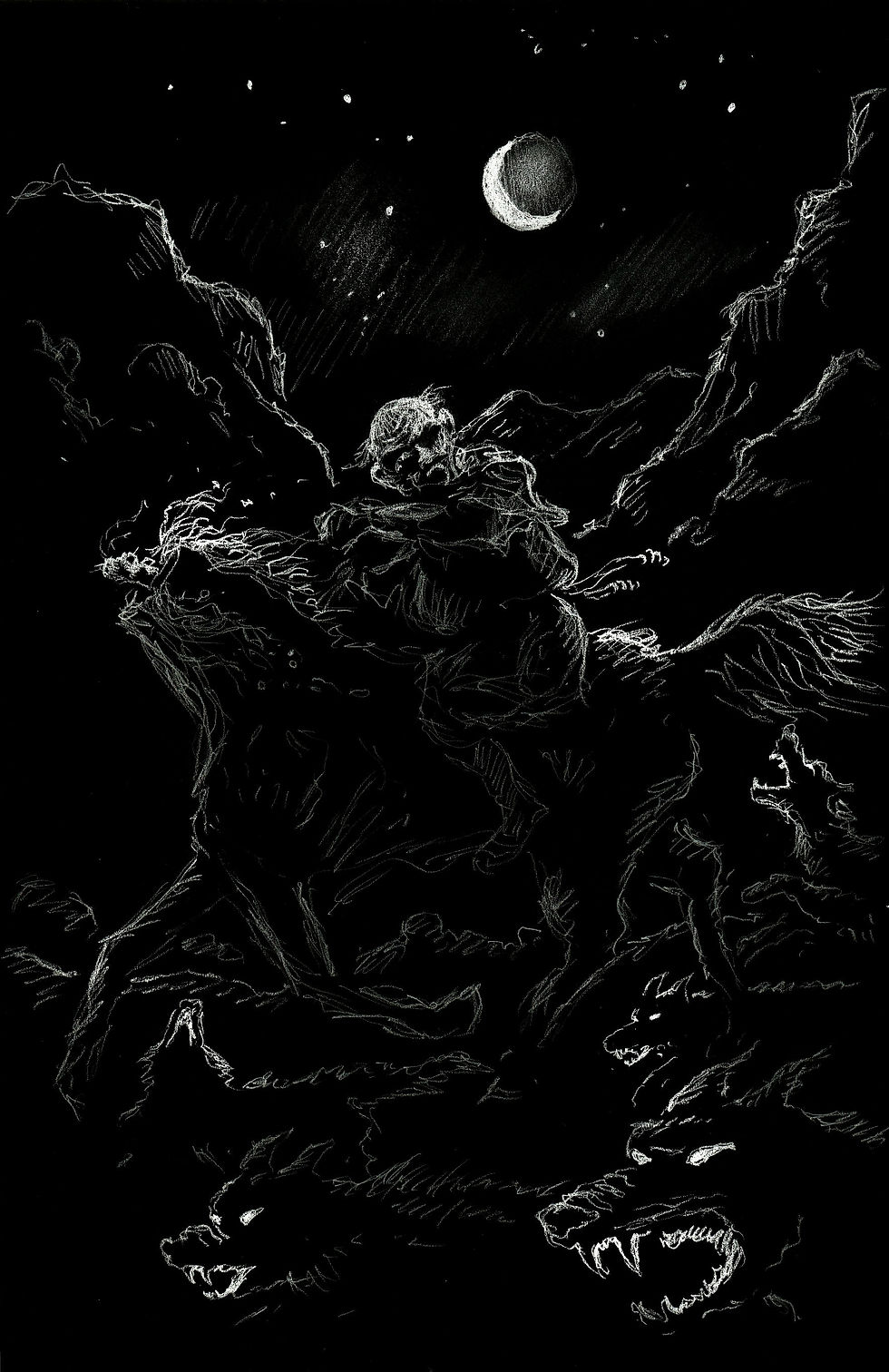
Determined to escape before the friar impoverishes him completely, Lope secretly prepares to flee Granada with his remaining treasure. He hides his mule in a vault beneath the Tower of the Seven Floors, a place feared because it is associated with the Belludo, a legendary goblin horse pursued by hellhounds. Somehow learning of Lope’s plan, Fray Simon conceals himself along the avenue leading from the Alhambra. When he hears hoofbeats in the darkness, he leaps onto what he believes is Lope’s mule. Instead, he finds himself astride the terrible Belludo.
The goblin horse races wildly through Granada while “a pack of seven hounds” howls behind it. Fray Simon is battered, bruised, and terrified as he is carried through the streets all night. Every prayer or invocation only makes the creature gallop faster. At dawn, the Belludo throws the friar violently to the ground before vanishing into the tower with the infernal dogs. Fray Simon later discovers that the wreath and gold he had extorted from Dame Sanchez have transformed into “sand and gravel.”
Years afterward, one of Lope Sanchez’s old companions encounters him in Málaga living in great wealth and celebrating the marriage of Sanchica to a Spanish grandee. Though Lope claims that he inherited a copper mine in America, the people of Granada continue to believe that his fortune came from the hidden Moorish treasure guarded by the “two discreet statues” of the Alhambra.
ANALYSIS

The great theme of this story is, of course, discretion. The word itself (or variations of it) appears repeatedly throughout the narrative, and the characters are defined by either their ability to keep secrets (Lope and Sanchica) or their inability to do so (Dame Sanchez and Fray Simon). The great irony of this dichotomy, however, is that the most discreet character — and the one personally entrusted with the secret by the Gothic princess — is a little girl, while the least trustworthy figure is Fray Simon: a father confessor with a suspiciously intimate relationship with the town’s devout women and an implied brood of illegitimate dependents to support.
A corpulent counterpart to Ichabod Crane, this greedy meddler suffers a comic punishment rooted in another widespread folk superstition. The goblin horse pursued by hellhounds recalls several European folkloric traditions: the Irish Púca, the spectral riders of the Germanic Wild Hunt, and the Scottish Kelpie. In each case, it is deeply perilous to find oneself mounted upon such a supernatural beast; Kelpies in particular were said to possess adhesive backs that trapped riders until they were dragged to their deaths.
II.
As is often the case in Tales of the Alhambra, Irving ultimately rewards humility, courage, and good nature while humiliating greed and corruption. Lope is rewarded for his generosity and cheerful simplicity; Sanchica for her “faith and courage”; and even Dame Sanchez is partially redeemed for her indiscreet “tattling” because her motives are rooted in sincere religious concern rather than selfishness. Fray Simon, by contrast, suffers both physical humiliation and symbolic exposure: stripped of dignity, bruised nearly senseless, and deprived of the wealth he attempted to exploit.
In keeping with older folktales about treasure granted through supernatural means, his stolen riches dissolve into worthless sand and gravel. Even the Gothic princess receives the hope of eventual release from enchantment and purgatorial suffering through the prayers and masses promised in her name. Meanwhile, the scheming astrologer is rendered symbolically powerless: his phallic staff loses its potency when touched by Sanchica’s talisman, and he lapses into an eternal enchanted sleep — a Moorish counterpart to Rip Van Winkle, suspended helplessly outside the flow of history.
One further element worth noting is the story’s fascination with inheritance and cultural succession. Throughout the tale, Christian Spain quite literally inhabits the ruins of Moorish civilization, inheriting its palaces, treasures, legends, and anxieties. The enchanted halls beneath the Alhambra suggest that the Islamic past has not vanished so much as gone dormant beneath the surface of Spanish identity, waiting to emerge on nights when the barriers between worlds grow thin.
Significantly, it is not soldiers, priests, or nobles who are granted access to this hidden legacy, but a child whose innocence allows her to move safely between the Christian and Moorish worlds. Irving therefore treats the Alhambra not merely as a ruined monument, but as a symbolic repository of memory itself — a haunted space where history, folklore, religion, and fantasy continue to coexist uneasily.