top of page


The
CLASSIC HORROR BLOG
Literary Essays on Classic Horror, Ghost Stories, & Weird Fiction
— from Mary Shelley to M. R. James —
by M. Grant Kellermeyer


FEEDSPOT'S #2 TOP HORROR STORY BLOG:
2024, 2025, 2026
GOTHIC NOVELS & NOVELLAS
MACABRE MASTERS BEST STORIES BY AUTHOR
STORY SUMMARIES & ANALYSES HORROR FICTION TROPES
FILM ADAPTATIONS NEW BOOK REVIEWS HOLIDAY STORIES
— CLICK ON A NAME TO SEE ALL ESSAYS ON THAT WRITER —
E. F. BENSON AMBROSE BIERCE ALGERNON BLACKWOOD RHODA BROUGHTON
ROBERT W. CHAMBERS F. MARION CRAWFORD GUY DE MAUPASSANT CHARLES DICKENS
SIR ARTHUR CONAN DOYLE LORD DUNSANY AMELIA B. EDWARDS ELIZABETH GASKELL
WILLIAM HOPE HODGSON E. T. A. HOFFMANN WASHINGTON IRVING W. W. JACOBS
HENRY JAMES M. R. JAMES RUDYARD KIPLING J. SHERIDAN LE FANU GASTON LEROUX
H. P. LOVECRAFT ARTHUR MACHEN EDITH NESBIT FITZ-JAMES O'BRIEN
MARGARET OLIPHANT OLIVER ONIONS EDGAR ALLAN POE
MARY SHELLEY ROBERT LOUIS STEVENSON BRAM STOKER
H. G. WELLS EDITH WHARTON OSCAR WILDE


Robert Louis Stevenson's The Waif Woman, Explained: A Detailed Summary and a Literary Analysis
Repressed by Stevenson at his wife’s insistence, “The Waif Woman” – published posthumously (and only after Mrs. Stevenson’s death) is an adaptation of a ghost story told in chapters 50-55 of the Icelandic Erybyggja Saga. The story certainly is scandalous, even by Stevenson’s standards, and presents perhaps his most brutal indictment of material greed yet. The setting is Iceland at the turn of the first Millennium, circa 999 C.E., the date when Christianity was formally adopte
Michael Kellermeyer
May 25, 2022


Edgar Allan Poe's A Descent into the Maelström, Explained: A Detailed Summary and a Literary Analysis
Like its thematic predecessor, “MS. Found in a Bottle,” “A Descent into the Maelström” delves into themes of natural sublimity, seagoing adventure, philosophical horror, and irrational curiosity. Where “MS.” built its philosophy on a folkloric foundation of Flying Dutchman legends and hollow-earth theories, this tale is centered on the maritime legends of the Norway Maelström. Although the actual whirlpool is barely powerful enough to sink a yacht, Poe is more interested in p
Michael Kellermeyer
Apr 26, 2022


A Ghost Story for Easter: Ager's Martyrdom & Paxton's Penance in M. R. James' Warning to the Curious
To the majority of his readership – especially those in the United Kingdom – M. R. James will forever be inextricably linked to the...
Michael Kellermeyer
Apr 13, 2022


Reviewing: J. Fremont's "Magician of Light"
As a devotee of Arthur Machen, Oliver Onions, Robert W. Chambers, Algernon Blackwood, and their ilk, I must confess to have a soft spot...
Michael Kellermeyer
Apr 13, 2022


Arthur Machen's The Novel of the White Powder, Explained: A Detailed Summary and a Literary Analysis
One of Machen’s most anthologized stories – and certainly his most gruesome – “The Novel of the White Powder” is an excerpt from The Three Imposters – a novel written in the style of Robert Louis Stevenson, but with the pure, burning mysticism that only Arthur Machen could bring to the slums, parks, and townhouses of fin de siècle London. The novel concerns three suspicious strangers – a woman and two men – who accost a pair of bohemian dandies, ostensibly in search of a nerv
Michael Kellermeyer
Apr 4, 2022


Reviewing: Geoff Woodbridge's "Something Weird, Something Strange"
To begin with, from the very first moment that I read Woodbridge's fiction, I was struck by how rare and delicious it is to find a...
Michael Kellermeyer
Mar 31, 2022
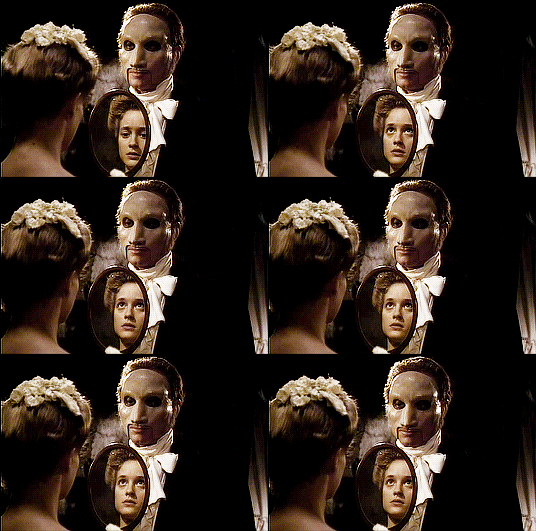
Top 7 Film and Stage Adaptations of The Phantom of the Opera
“The Opera Ghost really existed…” Such are the opening lines of Gaston Leroux’s Edwardian homage to the Belle Epoque. Pregnant with...
Michael Kellermeyer
Mar 2, 2022


J. Sheridan Le Fanu's Madam Crowl's Ghost, Explained: A Detailed Summary and a Literary Analysis
By the early Twentieth Century, J. Sheridan Le Fanu was largely only remembered for three or four Gothic mystery novels – The House by the Churchyard, The Wyvern Mystery, and Uncle Silas – “Carmilla,” and – in some circles – “Green Tea.” Le Fanu’s ghost stories—now considered his most significant literary contribution—were largely forgotten or dismissed as too weird, vague, or inscrutable. In 1923, M. R. James resurrected Le Fanu by editing a collection of his best ghost stor
Michael Kellermeyer
Feb 22, 2022


Reviewing: The Unhallowed Horseman by Jude S. Walko
As any of you who have followed my blog for long are surely aware, I have a special affection for all things Washington Irving and “The...
Michael Kellermeyer
Feb 22, 2022


Ambrose Bierce's The Moonlit Road, Explained: A Detailed Summary and a Literary Analysis
Bierce’s most famous ghost story has all the hallmarks of a typical supernatural tale from his pen: it is broken into multiple sections, beginning in media res, tells a confusing story from different points of view (allowing clarity to come only after all sides are given a chance to present their impressions), and details acts of craven violence between seemingly devoted family members. The story borrows heavily from Edgar Allan Poe, especially the second chapter, and uses tr
Michael Kellermeyer
Feb 7, 2022


M. R. James' The Story of a Disappearance and an Appearance, Explained: A Detailed Summary and a Literary Analysis
This story is famous for two reasons: firstly, it is the only one of James’ stories which is set specifically over Christmas (while some – Martin’s Close, Oh Whistle, etc. – are set near Christmas, this is the only one to explicitly take place on December 25th), a holiday with which James is ubiquitously associated, and secondly, it is “the one with the demented Punch and Judy Show.” Once a childhood staple, Punch and Judy Shows – which are hardly politically correct – are in
Michael Kellermeyer
Dec 21, 2021


E. T. A. Hoffmann's The Entail, Explained: A Detailed Summary and a Literary Analysis
One of Hoffmann’s most ambitious attempts at Gothic fiction is also one of his more complex: involving multiple plots layered one over the other, jumping back and forth in time, with entire casts of characters existing in each timeline. Biographically, the framing narrative about an emotionally flustered young man’s aborted dalliance with a married woman borrows from Hoffmann’s own scandalous attentions toward Dora Hatt. As with the young Julia Marc, Dora was one of Hoffmann’
Michael Kellermeyer
Dec 15, 2021


M. R. James' Disturbingly Invasive, Introspective Ghost Stories: A Deep Literary Analysis (Part II)
NOTE: This second and final post is continued from Part I, where we explored James' transformation of the ghost story genre, his own...
Michael Kellermeyer
Dec 2, 2021


M. R. James' Disturbingly Invasive, Introspective Ghost Stories: A Deep Literary Analysis (Part I)
“He who fights with monsters should look to it that he himself does not become a monster. And if you gaze long into an abyss, the abyss...
Michael Kellermeyer
Nov 17, 2021


M. R. James' Oh, Whistle and I'll Come to You, My Lad, Explained: A Detailed Summary and a Literary Analysis
NOTE: The following article is largely excerpted (other than the summary) from our most recent collection: A Warning to the Curious, Count Magnus, and Other Horrors: The Best Ghost Stories and Weird Fiction of M. R. James, Annotated and Illustrated. None of M. R. James’ ghost stories have rivalled the resilient power or popularity of “Oh, Whistle and I’ll Come to You, My Lad.” It is almost always the first-ranked tale in polls of his readership (voted number one twice by the
Michael Kellermeyer
Nov 5, 2021


I Come to the Garden Alone: A Ghost Story for Hallowe'en
NOTE: Each October I write a ghost story or weird tale for Hallowe'en and post it here. The following piece is 2021's "Ghost Story for...
Michael Kellermeyer
Oct 27, 2021


How We Make Our Illustrations
This is a quick and fun look behind the scenes at how our books are made. One of the most common questions I get in my inbox is how...
Michael Kellermeyer
Oct 20, 2021


Top Film Adaptations of Frankenstein: from the Early Icons to Dark Re-imaginings
Like his peers Dracula and Sherlock Holmes, Frankenstein's Creature has been featured extensively in film – both adaptations of the...
Michael Kellermeyer
Oct 11, 2021


The Picture of Dorian Gray: Inspirations, Interpretations, and a Literary Analysis
Ever since its explosive publication in 1890, Oscar Wilde's Gothic treatise on decadence, sin, and corruption has been subject to scandal...
Michael Kellermeyer
Sep 29, 2021


The Most Underrated Tales of Poe (Part 3 of 3): 10 Best, Forgotten Fantasy Stories
In this three-part series we will explore the forgotten tales of Poe: stories of Gothic horror, black humor, and fantasy/suspense that...
Michael Kellermeyer
Aug 18, 2021


The Most Underrated Tales of Poe (Part 2 of 3): 10 Best, Forgotten Black Humor Stories
In this three-part series we will explore the forgotten tales of Poe: stories of Gothic horror, black humor, and fantasy/suspense that...
Michael Kellermeyer
Jul 21, 2021


The Most Underrated Tales of Poe (Part 1 of 3): 10 Best, Forgotten Horror Stories
In this three-part series we will explore the forgotten tales of Poe: stories of (1) Gothic horror, (2) black humor, and (3) strange...
Michael Kellermeyer
Jul 7, 2021


Frightful Forests: 13 of the Best Classic Stories of Haunted Woods and Cursed Campers
(Updated from August 2017) Every summer there are nights that I feel the urge to wander into the shady woods of my native Midwest: the...
Michael Kellermeyer
Jun 23, 2021


Ambrose Bierce's The Damned Thing, Explained: A Detailed Summary and a Literary Analysis
Invisibility in literature is as old as history itself. Some the earliest references come from Greek and Roman mythology – such as the “Ring of Gynges” spoken of by Plato. In this revealing story, a shepherd discovers a ring of invisibility that he uses to seduce the Queen of Lydia and murder the king. It hints at both sides of the issue: the possibility (invisibility could raise a shepherd to a king) and the horror (even a king has no defense against an invisible man), and c
Michael Kellermeyer
Jun 14, 2021
bottom of page