top of page



The
CLASSIC HORROR BLOG
Literary Essays on Classic Horror, Ghost Stories, & Weird Fiction
— from Mary Shelley to M. R. James —
by M. Grant Kellermeyer


FEEDSPOT'S #2 TOP HORROR STORY BLOG:
2024, 2025, 2026
GOTHIC NOVELS & NOVELLAS
MACABRE MASTERS BEST STORIES BY AUTHOR
STORY SUMMARIES & ANALYSES HORROR FICTION TROPES
FILM ADAPTATIONS NEW BOOK REVIEWS HOLIDAY STORIES
— CLICK ON A NAME TO SEE ALL ESSAYS ON THAT WRITER —
E. F. BENSON AMBROSE BIERCE ALGERNON BLACKWOOD RHODA BROUGHTON
ROBERT W. CHAMBERS F. MARION CRAWFORD GUY DE MAUPASSANT CHARLES DICKENS
SIR ARTHUR CONAN DOYLE LORD DUNSANY AMELIA B. EDWARDS ELIZABETH GASKELL
WILLIAM HOPE HODGSON E. T. A. HOFFMANN WASHINGTON IRVING W. W. JACOBS
HENRY JAMES M. R. JAMES RUDYARD KIPLING J. SHERIDAN LE FANU GASTON LEROUX
H. P. LOVECRAFT ARTHUR MACHEN EDITH NESBIT FITZ-JAMES O'BRIEN
MARGARET OLIPHANT OLIVER ONIONS EDGAR ALLAN POE
MARY SHELLEY ROBERT LOUIS STEVENSON BRAM STOKER
H. G. WELLS EDITH WHARTON OSCAR WILDE


Two of Fitz-James O’Brien’s Gothic Poems (The Ghosts & The Demon of the Gibbet) Explained with their Full Text
Fitz-James O’Brien occupies a distinctive, if often overlooked, place in nineteenth-century Gothic literature, bridging the spectral introspection of American dark romantics with the folkloric terrors of his Irish heritage. Best known for his macabre short fiction, O’Brien was equally adept as a poet, crafting verse that mingles psychological unease with supernatural spectacle. His Gothic imagination thrives in liminal spaces—between life and death, dream and waking, the mate
Michael Kellermeyer
Dec 10, 2025


NEW RELEASE: Second Edition of The Picture of Dorian Gray - Now Fully Annotated, Expanded, and Revised
Last autumn, I began an ambitious project: returning to every anthology in my catalogue and relaunching each one as a fully restored, expanded, and comprehensively annotated edition. Many of the earlier volumes were originally produced while I was balancing publishing alongside a full-time teaching career, which meant making difficult choices about where to devote my limited editorial time. In order to continue releasing several books each year, I generally reserved detailed
Michael Kellermeyer
Dec 1, 2025


Oscar Wilde's The Sphinx Without a Secret, Explained: A Detailed Summary and Literary Analysis
The theme of public attention and appearance runs like a bright thread through nearly all of Oscar Wilde’s plays and stories. In The Importance of Being Earnest, it is far more important to be “Ernest” than to be earnest, because the name itself carries an aura of desirability: the illusion is more powerful than the reality. Throughout Wilde’s fiction, reality and illusion—truth and perception—exist in deliberate, often comic conflict. His characters care surprisingly little
Michael Kellermeyer
Nov 21, 2025


Oscar Wilde's Lord Arthur Savile's Crime, Explained: A Detailed Summary and Literary Analysis
Oscar Wilde was fascinated by the concept of duty—not by its nobility, but by its absurdity. He delighted in exposing the ridiculous extremes to which humans will go when they allow social or moral obligation to govern their lives. In his work, duty often becomes a source of comic tension, revealing how blindly adhering to socially constructed expectations can produce outcomes both absurd and unsettling. Wilde presents duty not as a moral compass but as a lens through which h
Michael Kellermeyer
Nov 21, 2025


NEW RELEASE: Second Edition of The Invisible Man - Now Fully Annotated, Expanded, and Revised
Last autumn, I began an ambitious project: returning to every anthology in my catalogue and relaunching each one as a fully restored, expanded, and comprehensively annotated edition. Many of the earlier volumes were originally produced while I was balancing publishing alongside a full-time teaching career, which meant making difficult choices about where to devote my limited editorial time. In order to continue releasing several books each year, I generally reserved detailed
Michael Kellermeyer
Nov 11, 2025


Reviewing: Barry Maher's The Great Dick and the Dysfunctional Demon
It’s 1982. The narrator, Steve Witowski (an alias), is a failed songwriter and fugitive, already trying to escape his past. One night he intervenes to save a woman named Victoria from a brutal assault by a seemingly unstoppable attacker. Rather than moving on, Steve becomes entangled with Victoria, who has just purchased a dilapidated church with a dark, haunting past. As Steve stays on to help with the renovation and the mysteries of the place, he discovers that Victoria--an
Michael Kellermeyer
Nov 7, 2025


NEW RELEASE: Second Edition of Robert Louis Stevenson - Now Fully Annotated, Expanded, and Revised
Last autumn, I began an ambitious project: returning to every anthology in my catalogue and relaunching each one as a fully restored, expanded, and comprehensively annotated edition. Many of the earlier volumes were originally produced while I was balancing publishing alongside a full-time teaching career, which meant making difficult choices about where to devote my limited editorial time. In order to continue releasing several books each year, I generally reserved detailed
Michael Kellermeyer
Nov 1, 2025
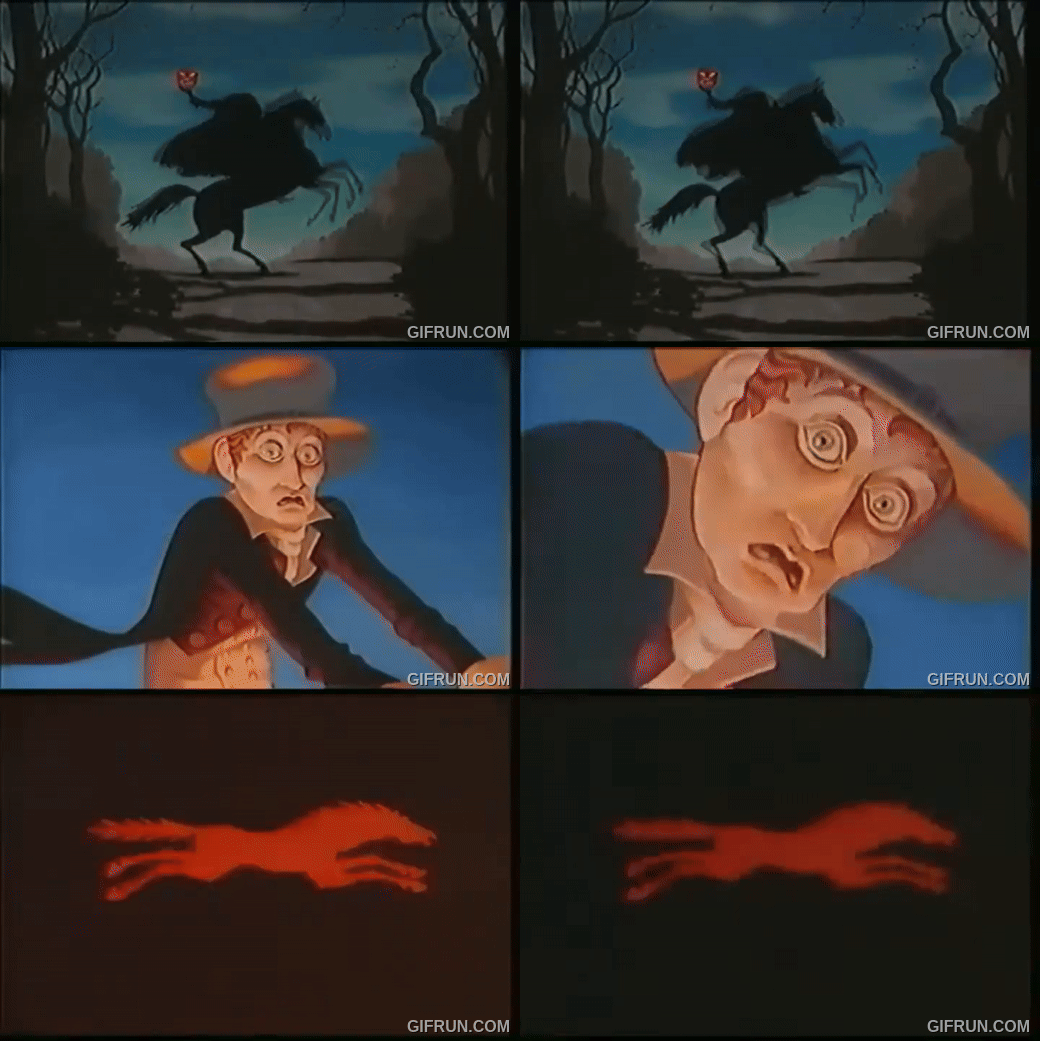
The 10 Best Film Adaptations of The Legend of Sleepy Hollow: A Definitive Analysis
This post has been an extremely long time in coming. As I've mentioned in many previous articles, “The Legend of Sleepy Hollow” is both my favorite story and the high-mark of my personal, literary expertise. Washington Irving has his own designated bookshelf in my living room (not including my collection of illustrated "Legend of Sleepy Hollow" editions), I was accepted into grad school based on the strength of a 20-page essay on Freudian subtexts in "Rip Van Winkle," and Irv
Michael Kellermeyer
Oct 25, 2025


Robert Louis Stevenson's The Bottle Imp, Explained: A Detailed Summary and Literary Analysis
Even outside of supernatural fiction circles, “The Bottle Imp” is among Stevenson’s most celebrated short stories. Its reputation stands alongside other perennial classics of the short form—Jacobs’ “The Monkey’s Paw,” Irving’s “The Devil and Tom Walker,” Bierce’s “An Occurrence at Owl Creek Bridge,” London’s “To Build a Fire,” and O. Henry’s “The Gift of the Magi.” Like these tales, Stevenson’s story is remembered for its taut suspense, ironic reversals, and unforgettable emo
Michael Kellermeyer
Oct 14, 2025


Robert Louis Stevenson's Markheim, Explained: A Detailed Summary and a Literary Analysis
“Markheim” stands among Stevenson’s most psychologically intricate tales, fusing the moral unease of the Victorian conscience with the atmospheric precision of a ghost story. Written in the same creative period that produced Dr. Jekyll and Mr. Hyde, it reveals Stevenson’s deep fascination with divided selves, hidden motives, and the possibility of moral regeneration. First published in the Pall Mall Christmas “Extra”, “Markheim” was intended for a seasonal audience expecting
Michael Kellermeyer
Oct 9, 2025


NEW RELEASE: Second Edition of Henry James - Now Fully Annotated, Expanded, and Revised
Last autumn, I began an ambitious project: returning to every anthology in my catalogue and relaunching each one as a fully restored, expanded, and comprehensively annotated edition. Many of the earlier volumes were originally produced while I was balancing publishing alongside a full-time teaching career, which meant making difficult choices about where to devote my limited editorial time. In order to continue releasing several books each year, I generally reserved detailed
Michael Kellermeyer
Oct 1, 2025


Revisiting the Shadows: Major Update on Our Annotated Anthologies - & a Free Gift for You!
This year, behind the scenes at Oldstyle Tales Press, we’ve been quietly undertaking one of the most ambitious projects in our publishing...
Michael Kellermeyer
Sep 30, 2025


Henry James' The Third Person, Explained: A Detailed Summary and Literary Analysis
Henry James’ ghost stories are almost always elegant and stately, wrapped in psychological tension and emotional complexity, and bereft of any Gothic indulgences – blood, rotting flesh, “horribly thin” legs, eyeless sockets, the odors of the grave. The following story is remarkable in that it breaks from James’ more serious entries and offers a moment of ghoulish fun, while still holding horror at bay. The tale is, in fact, a comedy – part of one of the most underrated subgen
Michael Kellermeyer
Sep 24, 2025


Henry James' The Way it Came (or, The Friend of the Friends), Explained: A Detailed Summary & Literary Analysis
Just months before he wrote The Turn of the Screw, Henry James penned its literary predecessor, a short story called “The Way it Came,” later (and more tellingly) titled “The Friend of the Friends.” Bereft of any supernatural terror, it is nonetheless intensely unsettling – a story that enlists the hereafter as an instrument to highlight the power of emotions which are no less mysterious and spiritual in nature: mistrust, jealousy, lust, fantasy, idolization, and that multila
Michael Kellermeyer
Sep 13, 2025


M. R. James' The Mezzotint, Explained: A Detailed Summary & Literary Analysis
One of James’ favorite horror motifs was the object which had the power to influence the perception of its owner – literally. The subject of the following story, a mezzotint, was a type of engraving made on a copper plate that was renowned for its ability to capture the luminous effects of soft light; as such, it was often used to print replicas of nocturnal oil paintings. The subjects of mezzotints frequently blended ethereal beauty with a sense of the otherworldly: they hav
Michael Kellermeyer
Sep 12, 2025


Henry James' Sir Edmund Orme, Explained: A Detailed Summary & Literary Analysis
For fifteen years after “The Ghostly Rental” (1876), Henry James placed himself under a self-imposed moratorium on supernatural fiction. He avoided what he called “romances” and concentrated instead on refining his realist technique—the careful psychological nuance, social observation, and subtle moral shading that would become his hallmark. But in 1891 he returned to the ghostly mode with “Sir Edmund Orme,” and the decade that followed proved to be his most fertile period fo
Michael Kellermeyer
Sep 12, 2025


H. P. Lovecraft / Sonia Haft Greene's The Horror at Martin's Beach, Explained: A Detailed Summary & Literary Analysis
Sonia Haft Greene was a widowed Ukrainian Jewish immigrant who had survived a childhood hounded by antisemitism, her father’s death, her mother’s immigration to New York, a violent marriage, the death of her three-month-old son, her husband’s suicide, and life as a working, single mother before she became romantically entangled with one Howard Philips Lovecraft – an unemployed, amateur sci-fi writer seven years her junior, living in his boyhood home with his two elderly aunts
Michael Kellermeyer
Sep 1, 2025


NEW RELEASE: Third Edition of W. W. Jacobs - Now Fully Annotated, Expanded, and Revised
Last autumn, I began an ambitious project: returning to every anthology in my catalogue and relaunching each one as a fully restored, expanded, and comprehensively annotated edition. Many of the earlier volumes were originally produced while I was balancing publishing alongside a full-time teaching career, which meant making difficult choices about where to devote my limited editorial time. In order to continue releasing several books each year, I generally reserved detailed
Michael Kellermeyer
Sep 1, 2025


W. W. Jacobs' Three at Table, Explained: A Detailed Summary and Literary Analysis
Jacobs was never one for a conventional ghost story. His horror tales are often marked by unexpected irony, chicanery, and twists. His ghosts are often blatant posers, figments of imagination, metaphors, or hazy possibilities. Even in “The Well” there is always the chance that the dead man merely becomes entangled in Benson’s tether and that all the poor luck that led him into that horrible pit was supernatural guidance. The following is a very curious story about a real ghos
Michael Kellermeyer
Aug 21, 2025


W. W. Jacobs' In the Library, Explained: A Detailed Summary and Literary Analysis
Edgar Allan Poe’s influence on W. W. Jacobs is unmistakable and surfaces repeatedly throughout Jacobs’ body of work. Poe’s tales such as Descent into the Maelstrom, The Oblong Box, MS. Found in a Bottle, and The Narrative of Arthur Gordon Pym left a discernible imprint on Jacobs’ nautical fiction. Like Poe, Jacobs deftly blends maritime jargon with sharp, often sardonic observations about human frailty, intellectual pride, vanity, and the ever-present shadow of fear. His sail
Michael Kellermeyer
Aug 14, 2025


W. W. Jacobs' His Brother's Keeper, Explained: A Detailed Summary and Literary Analysis
Jacobs’ penultimate horror tale belongs firmly to the esteemed tradition of the nervous homicide—a genre in which he had already shown a generous and skillful hand in works such as The Well, In the Library, and Three Sisters. It is no wonder he returned so often to this form: Jacobs possessed a rare, sharply attuned gift for portraying the psychological distress of a murderer, particularly the private erosion of composure that follows the act. Like its predecessors, this fi
Michael Kellermeyer
Aug 12, 2025


Reviewing: Alan Golbourn's The Last Breath Before Death
In a genre long haunted by glittering immortals and emotionally tormented antiheroes, The Last Breath Before Death feels like a jolt...
Michael Kellermeyer
Aug 10, 2025


W. F. Harvey's August Heat, Explained: A Detailed Summary and Literary Analysis
W. F. Harvey's "August Heat" is a compact yet chilling entry in the tradition of Edwardian supernatural fiction, notable for its uncanny restraint and psychological ambiguity. First published in Midnight House and Other Tales, the story belongs to a wave of early 20th-century weird fiction that emphasized atmosphere and suggestion over overt horror. Harvey, a Quaker and a doctor by training, was less prolific than his contemporaries, but his best stories—like "The Beast with
Michael Kellermeyer
Aug 1, 2025


NEW RELEASE: Second Edition of J. Sheridan Le Fanu - Now Fully Annotated, Revised, and Expanded
Last autumn, I began an ambitious project: returning to every anthology in my catalogue and relaunching each one as a fully restored, expanded, and comprehensively annotated edition. Many of the earlier volumes were originally produced while I was balancing publishing alongside a full-time teaching career, which meant making difficult choices about where to devote my limited editorial time. In order to continue releasing several books each year, I generally reserved detailed
Michael Kellermeyer
Jul 1, 2025
bottom of page